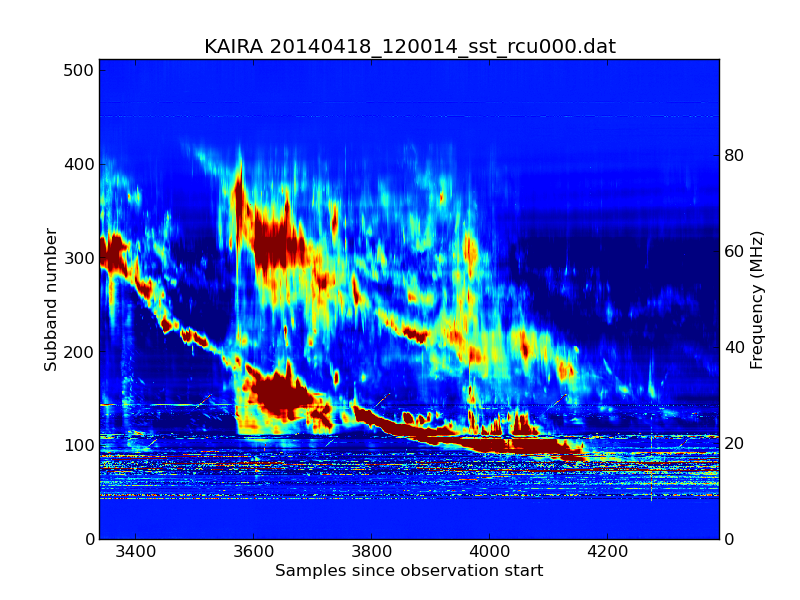
Last week, we reported on a spectacular solar event that we caught with KAIRA. As it turned out, the LOFAR station in England (UK608 Chilbolton) also caught the event, although only part of it.
Today, we have the data for the event as seen from both stations. Although we have a lot more KAIRA data, we have clipped it to make it match the same time range as the UK608 data.
Although very similar, there are some differences between the two stations. KAIRA's layout (REF) is different to that of the layout of UK608 (REF) and the UK station has twice the number of aerials. At the time of the measurement some of the KAIRA aerials were still out of action, due to the storm damage.
The stations are also at a different latitudes/longitudes. Therefore the relative topocentric position of the sun with respect to the two arrays is different. Certainly at KAIRA, the sun is lower in the sky. This also affects the relative position with respect to the polarisation orientation of the aerials (although the sun is largely unpolarised, the aerials do have a different response as we are only using one dipole for these measurements).
Finally, the radio-frequency interference (RFI) environments are slightly different between the two stations.
Showing posts with label UK608. Show all posts
Monday, 28 April 2014
Thursday, 24 April 2014
The Blue Land Rover
Come on... we can't visit Chilbolton without a gratuitous photograph of "my" old Blue Land Rover, can we?
![]() |
| The real reason I visited Chilbolton... (Photo: D. McKay-Bukowski) |
Tuesday, 22 April 2014
LOFAR UK608
Another post from our visit to the United Kingdom. Today we have some photographs from the LOFAR station at Chilbolton Observatory.
![]() |
| The UK608 high-band array... no snow, no frames. In the background is the 25m dish. (Photo: D. McKay-Bukowski) |
![]() |
| The UK608 low-band array. (Photo: D. McKay-Bukowski) |
Friday, 18 April 2014
Return to UK608
Today, I have been working at the LOFAR station at Chilbolton (UK608). We've been conducting system tests and have been investigating a radio-frequency interference (RFI) problem.
It is always nice to visit the observatory here. (And check that my old Land-Rover is doing okay.) So, today's photograph is from the observatory here in England.
Have a nice weekend.
Pip-pip!
![]() |
| Chilbolton Observatory (Photo: D. McKay-Bukowski) |
It is always nice to visit the observatory here. (And check that my old Land-Rover is doing okay.) So, today's photograph is from the observatory here in England.
Have a nice weekend.
Pip-pip!
Thursday, 3 April 2014
LOFAR Planetarium
As we know from the various images from KAIRA (including the latest all-sky image on the right), the LOFAR system is suitable for creating maps of the entire visible sky. With a day of observing, it is possible to therefore image the entire radio-sky as seen from that location.
Showing the entire sky is not easy; there are always issues with the projection to use and conveying a sense of angular scale. For visual observing the traditional way of doing this is via a planetarium.
In 2010, at the time I was working on the LOFAR-UK project, I had a conversation with Jenny Shipway from the Winchester Science Centre regarding the new LOFAR facility at Chilbolton. We realised that a planetarium would be ideal for portraying the data that the telescope could generate. A quick mock-up version was created using some 408 MHz data, which demonstrated that the concept was feasible.
Since then, the LOFAR-Planetarium idea was formalised and some more people got involved -- in particular, Andrew Fletcher, who now runs the project. We took a huge series of data from the LOFAR station at Chilbolton and generated high-resolution (3600x1800 pixel) images that can be projected directly from a digital planetarium, such as the one at Winchester.
Modern planetaria are capable of overlaying optical and radio data and fading seamlessly between them. Thus it is possible to use these images to demonstrate the relationship between the optical and radio sky and use this as a starting point to explain the astrophysics behind it.
The LOFAR Planetarium is a public outreach project of the LOFAR-UK consortium, funded by the Science and Technology Facilities Research Council (STFC) and Newcastle University.
Links:
Showing the entire sky is not easy; there are always issues with the projection to use and conveying a sense of angular scale. For visual observing the traditional way of doing this is via a planetarium.
In 2010, at the time I was working on the LOFAR-UK project, I had a conversation with Jenny Shipway from the Winchester Science Centre regarding the new LOFAR facility at Chilbolton. We realised that a planetarium would be ideal for portraying the data that the telescope could generate. A quick mock-up version was created using some 408 MHz data, which demonstrated that the concept was feasible.
Since then, the LOFAR-Planetarium idea was formalised and some more people got involved -- in particular, Andrew Fletcher, who now runs the project. We took a huge series of data from the LOFAR station at Chilbolton and generated high-resolution (3600x1800 pixel) images that can be projected directly from a digital planetarium, such as the one at Winchester.
![]() |
| The equirectangular projection of the radio sky (Image: lofar-planetarium.org.uk) |
Modern planetaria are capable of overlaying optical and radio data and fading seamlessly between them. Thus it is possible to use these images to demonstrate the relationship between the optical and radio sky and use this as a starting point to explain the astrophysics behind it.
The LOFAR Planetarium is a public outreach project of the LOFAR-UK consortium, funded by the Science and Technology Facilities Research Council (STFC) and Newcastle University.
Links:
Tuesday, 1 April 2014
Moving out
I've actually been gone for well over a year now, but my old office at RAL still had a few things in it. There had been no need to completely empty it, as there was sufficient desk space for temporary visitors and students to use it.
However, now there is a need for extra space at RAL, so that meant the final clear-out before the room was reallocated. During a recent visit to 'the Lab', that final pack was completed and I took one last photograph of the door that marked 'home' for a few years.
The inset panel on the door was a cutout from a planning map for the placement of the LOFAR UK608 Low-Band array.
However, now there is a need for extra space at RAL, so that meant the final clear-out before the room was reallocated. During a recent visit to 'the Lab', that final pack was completed and I took one last photograph of the door that marked 'home' for a few years.
![]() |
| The old office door... vale! |
Thursday, 5 September 2013
A meeting of old friends
Well, it has been a while, but it was lovely to see "my" blue Land Rover again! Okay, okay... it's not really mine, but I used it every day during the construction of LOFAR station UK608 and grew rather fond of it.
![]() |
| "My" blue Land Rover. (Photo: D. McKay-Bukowski) |
Wednesday, 4 September 2013
ASTRON at Chilbolton
Today I was at the Rawlings Array (the LOFAR station at Chilbolton, UK) to meet with the ASTRON engineers who specialise in radio-frequency and digital signal processing. It was an extremely productive day, which included some design work, software training and some work on the array itself looking at how to replace fron-end RF-boards in the HBA tiles.
![]() |
| ASTRON arrives at the Chilbolton Observatory. (Photo: D. McKay-Bukowski) |
![]() |
| Opening up an HBA tile for some RF-maintenance demonstrations. (Photo: D. McKay-Bukowski) |
Tuesday, 27 August 2013
The Rawlings Array
As reported on the LOFAR-UK web log today, on Tuesday 27th August, the LOFAR station UK608 at Chilbolton in the United Kingdom was renamed as "The Rawlings Array", in honour of Professor Steven Rawlings.
Professor Rawlings passed away in January 2012. Before his untimely death he was the Head of Astrophysics at Oxford University. He was a leading member of the LOFAR-UK community and played a major role in the construction of the UK LOFAR station during the critical build phase. He was a driving force of many other international projects, not just those in Great Britain, and was an outstanding leader and mentor to his staff and students.
The dedication ceremony at Chilbolton Observatory was attended by members of his family and members of the LOFAR-UK and international scientific communities.
![]() |
| The plaque unveiled in honour of Professor Steve Rawlings. Reflected off the surface of the plaque is the 25m Chilbolton dish. (Photo: A. Mallet) |
Professor Rawlings passed away in January 2012. Before his untimely death he was the Head of Astrophysics at Oxford University. He was a leading member of the LOFAR-UK community and played a major role in the construction of the UK LOFAR station during the critical build phase. He was a driving force of many other international projects, not just those in Great Britain, and was an outstanding leader and mentor to his staff and students.
![]() |
| The RF-container at the Rawlings Array. The new plaque is in the centre of the container side. In the background is the LBA array (Photo: A.Mallet) |
The dedication ceremony at Chilbolton Observatory was attended by members of his family and members of the LOFAR-UK and international scientific communities.
Sunday, 7 July 2013
The Chilbolton dish
Another photograph from the Observatory at Chilbolton. This time a close-up view of the 25m dish. This system operates as a weather radar and is also used for satellite tracking projects.
![]() |
| The 25m dish at Chilbolton. (Photo: D. McKay-Bukowski) |
Saturday, 6 July 2013
Wildflowers at UK608
This weekend I made a visit to the LOFAR station in the United Kingdom (UK608, Chilbolton) in order to work on various station calibration things for both KAIRA and LOFAR generally. While there, I went out to the field itself to see the antennas. Being at the height of the British summer (which lasts for 3-4 days on average), there were plenty of wild flowers in bloom, including some near and on the array itself.
![]() |
| Wild poppies near the LBA aerials. In the background is the 25m dish (Photo: D. McKay-Bukowski) |
![]() |
| More wildflowers near the aerials. Does anyone know what they are? (Photo: D. McKay-Bukowski) |
Wednesday, 15 May 2013
What a surprise!
Yesterday I received something really amazing in the post. At first I was completely puzzled by it: the package was quite plain, I didn't recognise the handwriting, there was no return address and the previous address was obscured.
So, completely baffled I opened it up to find a book. Wow! It was a book detailing the construction of the LOFAR station in England.
Entitled "The Installation of LOFAR UK608 in Chilbolton", it had entries and photographs from the early days of the project in late 2009, all the way through to the point when I formally left for the current project in Finland, which was in early 2013. Throughout its pages, were not just words and images, but memories of all the challenges and triumphs of that project.
But, the best thing was the dedication in the front of the book...
As I say, there was no return address or indication of who had organised this or written the dedication, but I am very grateful. It was a fantastic gift and I really appreciate it. It brought back lots of happy memories and I sincerely hope that the LOFAR-UK community has as much fun and success using their LOFAR station as I did in building it.
With thanks,
Derek.
![]() |
| The mystery package |
So, completely baffled I opened it up to find a book. Wow! It was a book detailing the construction of the LOFAR station in England.
![]() |
| Wow! That was TOTALLY unexpected. |
Entitled "The Installation of LOFAR UK608 in Chilbolton", it had entries and photographs from the early days of the project in late 2009, all the way through to the point when I formally left for the current project in Finland, which was in early 2013. Throughout its pages, were not just words and images, but memories of all the challenges and triumphs of that project.
![]() |
| Happy memories. (Hey, there's 'my' blue Land Rover!) |
But, the best thing was the dedication in the front of the book...
![]() |
| :-) |
As I say, there was no return address or indication of who had organised this or written the dedication, but I am very grateful. It was a fantastic gift and I really appreciate it. It brought back lots of happy memories and I sincerely hope that the LOFAR-UK community has as much fun and success using their LOFAR station as I did in building it.
With thanks,
Derek.
Monday, 24 September 2012
First international experiment
This week, KAIRA is participating for the first time in a large international experiment with baselines of several thousands of kilometres. Apart from hoping to discover some new science, this is a perfect opportunity to link EISCAT, LOFAR and, of course, KAIRA itself. As the week goes on, we will be incorporating more and more stations into this experiment network. However, on this first night of observing the following stations are involved (from North to South):
The observations are being carried out at approximately 224 MHz (thus allowing us to use the Kiruna receiver station). The ESR is at a different frequency, but is providing concurrent observing. And both KAIRA and UK608 are using special observing modes. Kiruna and the ESR are conventional, mechanically-steered, parabolic dishes. The others are all LOFAR-design phased arrays.
People often ask if KAIRA is part of the LOFAR network. The answer to this is: "not directly". Although there are plans to one day link KAIRA directly to LOFAR via a high speed link, we are currently running as an independent station. While this gives us the flexibility to pursue our own science programme, it certainly does not preclude us from participating in large, important, observing experiment — like this one.
Oh... and we should also point out that although this particular experiment is being run by ASTRON, this work is being done by ASTRON staff at the KAIRA site!
Stay tuned as the week goes on as, no doubt, we will have some very interesting things to report!
- ESR (EISCAT Svalbard Radar, Norway)
- KAIRA (Kilpisjärvi Atmospheric Imaging Receiver Array, Finland)
- Kiruna (EISCAT receiver station, Sweden)
- SE607 (LOFAR station at Onsala, Sweden)
- DE604 (LOFAR station at Potsdam, Germany)
- UK608 (LOFAR station at Chilbolton, UK)
- FR606 (LOFAR station at Nançay, France)
The observations are being carried out at approximately 224 MHz (thus allowing us to use the Kiruna receiver station). The ESR is at a different frequency, but is providing concurrent observing. And both KAIRA and UK608 are using special observing modes. Kiruna and the ESR are conventional, mechanically-steered, parabolic dishes. The others are all LOFAR-design phased arrays.
People often ask if KAIRA is part of the LOFAR network. The answer to this is: "not directly". Although there are plans to one day link KAIRA directly to LOFAR via a high speed link, we are currently running as an independent station. While this gives us the flexibility to pursue our own science programme, it certainly does not preclude us from participating in large, important, observing experiment — like this one.
Oh... and we should also point out that although this particular experiment is being run by ASTRON, this work is being done by ASTRON staff at the KAIRA site!
Stay tuned as the week goes on as, no doubt, we will have some very interesting things to report!
Thursday, 2 August 2012
LOFAR station UK608
It is always interesting to see new LOFAR stations start to appear on the satellite photographs and Internet mapping sites. And one of the more recent additions is the LOFAR station in the United Kingdom. This is a particularly good site to look at, as there is a 25m dish nearby for comparison. It certainly gives a good idea of the scale of the LOFAR site!
This particular resolution photograph was probably taken in late 2011. We can tell this based on the materials around the LOFAR field itself and the state of the field. There are also cars parked near the gate to the main observatory compound, which would date from the time of the preparation of painting works for the 25m dish.
The UK608 station was officially opened by Dame Jocelyn Bell Burnell on 20 September 2010. Its LOFAR designation is UK608. It is operated by the LOFAR-UK consortium, which is the largest astronomy collaboration in the United Kingdom, involving scientists from 24 institutes. LOFAR-UK also have a web log (http://blog.lofar-uk.org/) for their project.
References:
Friday, 30 September 2011
LOFAR-UK observes the active sun
Over the last few days, our Sun has been very active. Apart from the dedicated solar instruments monitoring this activity, we've also been able to observe it with the LOFAR radio telescope at Chilbolton. This facility comprises two fields of small antennas, that link together to perform as a powerful VHF radio telescope. Although it is also possible to link the LOFAR system in the UK with others across Europe, on the 28th September 2011, it was operating independently.

At 16:10 UTC (= 5:10 pm local time), LOFAR Chilbolton was used to record an 'all-sky' image. Even before calibration and analysis, this image shows the bright objects in the radio sky. On the left-hand side of the image there are, from top to bottom, Cassiopeia-A (a supernova remnant), Cygnus-A (a radio-galaxy) and the broader region which is the centre of our own Galaxy. However, to the right of the image, the Sun can be seen with extremely strong intensity, just before it set below the western horizon.
The image shown was made using the UK608 LBA. It demonstrates what a LOFAR station is capable of, even when working alone and independent of the main International LOFAR network. The image is not calibrated nor cleaned in anyway. The observations were made by Menno Norden (ASTRON), and the report by Derek McKay-Bukowski (STFC).
The web release is also available from STFC's "RAL Space" website: http://www.stfc.ac.uk/RALSpace/Areas+of+expertise/Astronomy/LOFAR-UK/In+the+news/37611.aspx
Subscribe to:
Posts (Atom)