Showing posts with label LOFAR. Show all posts

Friday, 15 August 2014

LOFAR Aerial Photos – Nançay

Another of the LOFAR sites has become visible in aerial imagery. The French site at Nançay can now be seen in Apple's Maps.app, which is supplied with iPhones and iPads. If you want to find it yourself, here are the co-ordinates: 47°22.54'N, 2°11.56'E, or go to Nançay and look for the large T-shaped antenna array north of the town. Under the left "arm" of the T, you'll find the LOFAR site.

Photo: Apple Maps.app.

Monday, 14 July 2014

Third LOFAR Data Processing School

The Third LOFAR Data Processing School will take place at ASTRON in Dwingeloo (The Netherlands), in the week of 17-21 November 2014.

The aim of this School is to introduce the LOFAR system to users and new members of the collaboration who will analyse Cycle data. Students, postdocs, and staff are all encouraged to attend. The school will cover the many aspects of the LOFAR system from the capabilities of the basic station hardware to the software pipelines and science products they produce. Members of the LOFAR project will present lectures and tutorials. Hands-on sessions will also be provided to give attendees an opportunity to gain experience with real LOFAR data.

Presentations will be given at a level appropriate for someone new to LOFAR. Familiarity with the concepts of radio interferometry and standard data processing software such as CASA, AIPS, or Myriad will be useful, but not required. Minimum requirements should include some familiarity with scripting languages and in particular Python. Participants are expected to bring fairly recent Linux or Mac OS laptops with tens of GB of disk space.

The school will be hosted by ASTRON (Dwingeloo). Note that registration to the School is on a first come - first serve basis and limited to 40 participants. In case you are interested in attending the school, we encourage you to proceed with the online registration as soon as possible: http://www.astron.nl/lofarschool2014/registration.php

http://www.astron.nl/lofarschool2014/
lofarschool@astron.nl

Wednesday, 18 June 2014

Plotting single-station LOFAR data with the R programming language

The R programming language is a free  (GNU Public Licence) language and environment use for scientific computing. It has developed a strong reputation for being used for statistics and data analysis, although its use goes far beyond that. It is easily extensible with function packages and has an active community. Staff at Sodankylä Geophysical Observatory use R, particularly for signal processing and inverse problem methods.

I myself have never used R before; my native language is actually C, with PostScript, Python, FORTRAN as some of the others that I know. I've been aware of R because my colleagues use it, but other than that I've not had a chance to use it. I keep meaning to write something, but those opportunities rarely come up and, when they do, it is usually faster to hack something out in a language I know.

But a couple of days ago an good opportunity presented itself, so here's my first real programme beyond the "Hello world!".

Lassi has asked for some KAIRA data, in particular some beamlet statistics data. These are the data generated by any LOFAR single station. Not only did he want the data, but also a way to plot it... using R (which is what he uses). Fair enough. So here's my attempt:


R-code to plot a single beamlet from a LOFAR beamlet statistics (BST) file.

   # Set the name of the file that we wish to read
   filename = "20131220_150320_bst_00X.dat"

   # Set the beamlet number we wish to plot
   beamlet = 243

   # Create a connection to this file
   file = file(filename,"rb")

   # Typical maximum file size (244 beamlets x 86400 seconds/day)
   maxsize = 244 * 86400

   # Read the entire file as a raw data stream (up to maxsize)
   raw = readBin(file,double(),size=8,n=maxsize,endian="little")

   # Re-shape the data into matrix w/ 244 columns (beamlets)
   data = matrix(raw,ncol=244,byrow=TRUE)

   # Convert the data into a dB scale
   data_db = 10.0*log10(data)

   # Create an array of sample numbers for the X-axis
   sample_num = array(1:dim(data_db)[1])

   # Plot the data (we need "beamlet+1"; R counts from 1, not 0)
   plot(sample_num,data_db[,beamlet+1],
        xlab="Samples since file start time",
        ylab=expression("ADUs 10log"[10]),
        main=paste("KAIRA   ",filename,"   Beamlet=",beamlet) )


The plot looks like this:


I also plotted the same thing with KPB (KAIRA Plot Beamlet-statistcs). KPB is the python software that we normally use for plotting things.


For those curious, the command line settings for this were:


   %  kpb --db -y 243 20131220_150320_bst_00X.dat -g trace \
          -t "KAIRA   %n   bl=243" -o kpb_example.png

Of course I will continue to use Python and C code, as that is what I do. However, hopefully the above code fragment will help anyone either learning R or getting started with LOFAR single-station data.

Bear in mind that I am a novice though! So, if you're an R-expert and have suggestions on how I could improve that code, or make it more R-esque, do let us know in the comments below!


Links

Monday, 28 April 2014

Comparing solar data

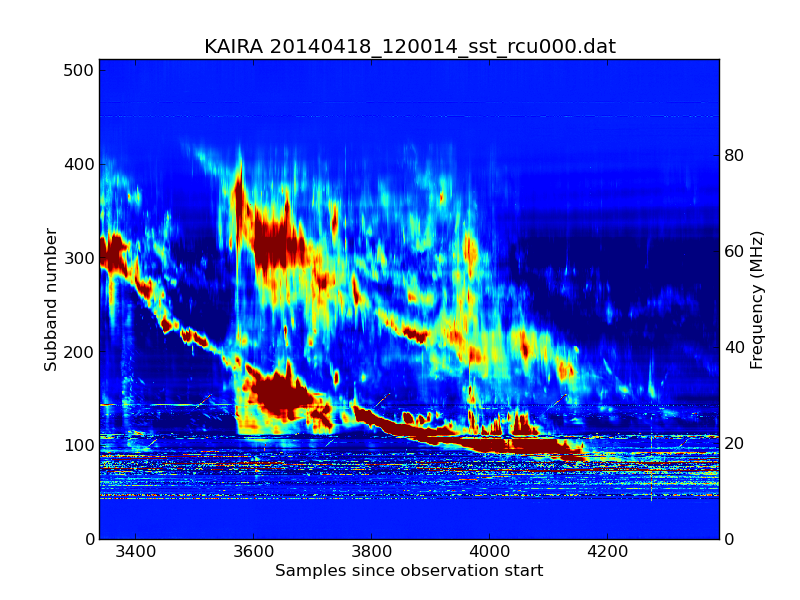
Last week, we reported on a spectacular solar event that we caught with KAIRA. As it turned out, the LOFAR station in England (UK608 Chilbolton) also caught the event, although only part of it.

Today, we have the data for the event as seen from both stations. Although we have a lot more KAIRA data, we have clipped it to make it match the same time range as the UK608 data.


Although very similar, there are some differences between the two stations. KAIRA's layout (REF) is different to that of the layout of UK608 (REF) and the UK station has twice the number of aerials. At the time of the measurement some of the KAIRA aerials were still out of action, due to the storm damage.

The stations are also at a different latitudes/longitudes. Therefore the relative topocentric position of the sun with respect to the two arrays is different. Certainly at KAIRA, the sun is lower in the sky. This also affects the relative position with respect to the polarisation orientation of the aerials (although the sun is largely unpolarised, the aerials do have a different response as we are only using one dipole for these measurements).

Finally, the radio-frequency interference (RFI) environments are slightly different between the two stations.

Thursday, 24 April 2014

The Blue Land Rover

Come on... we can't visit Chilbolton without a gratuitous photograph of "my" old Blue Land Rover, can we?

The real reason I visited Chilbolton... (Photo: D. McKay-Bukowski)

Tuesday, 22 April 2014

LOFAR UK608

Another post from our visit to the United Kingdom. Today we have some photographs from the LOFAR station at Chilbolton Observatory.

The UK608 high-band array... no snow, no frames. In the
background is the 25m dish. (Photo: D. McKay-Bukowski)

The UK608 low-band array. (Photo: D. McKay-Bukowski)

Thursday, 10 April 2014

2014 LOFAR Science Workshop conference dinner

The conference dinner for the 2014 LOFAR Science Workshop was held in the Pakhuis de Zwijger on the waterfront in Amsterdam. With so many fantastic talks during the day, the entire evening was abuzz with amazing discussions and ideas. And, to keep everything focused further, the organisers had asked for speakers to provide high-resolution images of their projects and results. These were projected onto nine massive screens that surrounded the eating area.


Wednesday, 9 April 2014

KAIRA film


At the LOFAR Science Workshop 2014 in Amsterdam, we premièred the KAIRA film. This was produced by SiteEye in conjunction with Sodankylä Geophysical Observatory, U. Oulu, ASTRON, EISCAT, and many others. (Versions with subtitles in many languages will be posted later.)


Enjoy!


UPDATE!
The film is also available with Finnish subtitles (LINK). 

Tuesday, 8 April 2014

LOFAR station Norderstedt

Guten Tag! This is Germany calling!

At the Hannover Messe (the world's largest industrial fair), ASTRON, the University of Hamburg and Bielefeld University will sign tomorrow a contract for construction of a new German LOFAR station for the International LOFAR Telescope (ILT).

The new station will be located at Norderstedt, close to the city of Hamburg.


Click map to enlarge (image based on an original by ASTRON)


The additional of another station to the ILT network is important not just for the resources it provides to local education, research and industry, but because of its important contribution to the ILT itself. Each LOFAR station adds valuable collecting area, thus allowing astronomers to detect ever-fainter signals. However, the placement of the new station is such that it provides critical intermediate baselines, thus improving the imaging capabilities of the ILT.

But there is also the knowledge factor as well. Each new station gives an opportunity for new researchers and new expertise to join the strong ILT community. This is vital for the local knowledge base and the advancement of science for participating regions and countries.

In the case of the new German station, researchers at the University of Hamburg, led by Prof. M. Brüggen, specialise in studying the formation and evolution of clusters of galaxies from the early Universe to the present era. The group at Bielefeld University, led by Prof. D. Schwarz, studies the distribution of galaxies on the largest observable distances in the Universe, which carry imprints from the era of cosmological inflation.

Signing of the contract will take place tomorrow at the Holland High Tech Pavilion at the Hannover Messe, in Hall 2 booth D10 from 12:00 - 12:30 hours (CEST).


Link:
https://www.astron.nl/about-astron/press-public/news/contract-new-lofar-antenna-station/astron-university-hamburg-and-biel


Monday, 7 April 2014

LOFAR Science 2014

This week, is the LOFAR 2014 International Meeting, being held in Amsterdam.It features the LOFAR Users Meeting, the LOFAR Community Science Workshop and a workshop about LOFAR’s first all-sky survey, the Multifrequency Snapshot Sky Survey (MSSS).


KAIRA will feature in the LOFAR Community Science Workshop. This part of the conference is the third annual meeting of the LOFAR science collaboration since the onset of regular LOFAR science operations. These workshops aim to bring together members of the wider collaboration including active members of the Key Science Project teams as well as various EU and international members of the LOFAR user community. This part of the conference will last two full days and  will feature a wide range of talks on technical developments, software enhancements, improvements in calibration and imaging techniques, and of course exciting new scientific results. The workshop program will cover the gamut of the LOFAR science case from cosmology and extragalactic research to Galactic, planetary, and solar system topics.

Link:
http://www.astron.nl/lofarscience2014/

Thursday, 3 April 2014

LOFAR Planetarium

As we know from the various images from KAIRA (including the latest all-sky image on the right), the LOFAR system is suitable for creating maps of the entire visible sky.  With a day of observing, it is possible to therefore image the entire radio-sky as seen from that location.

Showing the entire sky is not easy; there are always issues with the projection to use and conveying a sense of angular scale. For visual observing the traditional way of doing this is via a planetarium.

In 2010, at the time I was working on the LOFAR-UK project, I had a conversation with Jenny Shipway from the Winchester Science Centre regarding the new LOFAR facility at Chilbolton. We realised that a planetarium would be ideal for portraying the data that the telescope could generate. A quick mock-up version was created using some 408 MHz data, which demonstrated that the concept was feasible.

Since then, the LOFAR-Planetarium idea was formalised and some more people got involved -- in particular, Andrew Fletcher, who now runs the project. We took a huge series of data from the LOFAR station at Chilbolton and generated high-resolution (3600x1800 pixel) images that can be projected directly from a digital planetarium, such as the one at Winchester.

The equirectangular projection of the radio sky (Image: lofar-planetarium.org.uk)

Modern planetaria are capable of overlaying optical and radio data and fading seamlessly between them. Thus it is possible to use these images to demonstrate the relationship between the optical and radio sky and use this as a starting point to explain the astrophysics behind it.

The LOFAR Planetarium is a public outreach project of the LOFAR-UK consortium, funded by the Science and Technology Facilities Research Council (STFC) and Newcastle University.

Links:

Monday, 7 October 2013

POLFAR -- The Polish LOFAR project

It is official!

Poland will build three new LOFAR stations.

The International LOFAR Telescope (ILT) comprises the combined LOFAR stations of  the Netherlands, Germany, France, Sweden and the United Kingdom. As we have been reporting, there are numerous other countries that are interested in joining the ILT and are attempting to raise the necessary funding to join this leading research project. It is therefore with the utmost delight that we report today that Poland is the latest to join the facility, and it intends to do so with major impact.

The Polish LOFAR Consortium (POLFAR) comprises:

  • Uniwersytet Jagielloński, Kraków, 
  • Centrum Badań Kosmicznych PAN, Warszawa, 
  • Uniwersytet Warmińsko-Mazurski, Olsztyn, 
  • Uniwersytet Mikołaja Kopernika, Toruń, 
  • Centrum Astronomiczne Mikołaja Kopernika Warszawa,Toruń, 
  • Uniwersytet Szczeciński, Szczecin, 
  • Uniwersytet Zielonogórski, Zielona Góra, 
  • Uniwersytet Przyrodniczy, Wrocław, 
  • Instytut Chemii Bioorganicznej PAN, 
  • Poznańskie Centrum Superkomputerowo.

It has now been officially announced that the Minister of Science and Higher Education prof. Barbara Kudrycka granted Polish consortium POLFAR 25.792.000 zł for the construction and equipment of three international stations of the European LOFAR radio astronomy system in Poland as part of their national research infrastructure investment.

Not one... but three!

Three International-class LOFAR stations is the equivalent of the LOFAR stations of France, Sweden and the UK combined! The proposed sites for the three stations are:
  • Borówiec, near Poznan,
  • Łazy, near Bochnia
  • Bałdy, near Olsztyn
The graphic at the head of this article shows the approximate locations of those sites. These will be constructed between 2013 and 2015. They will be linked by and ultra-fast network to a new regional supercomputing centre at Poznan, and from there connections will be made to the supercomputing faciltiy at Groningnen in the Netherlands

Polish scientists aim to push ahead in a number of areas of frontline research. These will include studies of galactic magnetic fields and their dynamic impact on the rarefied interstellar and intergalactic plasma, the timing of pulsars , the distribution of neutral hydrogen in the early universe. There are plans to study expiration and renewal of active galactic nuclei as well as more local studies of the magnetosphere of the giant planets in our solar system. The POLFAR consortium will also participate in commercial programs: global navigation and local environmental research.

On behalf of the KAIRA team, we congratulate POLFAR on this impressive step forward -- a move which will push Poland ahead as a major player in low-frequency radio astronomy. We shall watch the progress with excitement and shall look forward to the first amazing results.


Links (in Polish)

Sunday, 29 September 2013

LOFAR, EISCAT, SKA... and KAIRA of course!

Today's photograph was from the recent science seminar. Here, Prof. Markku Lehtinen explains the major projects and the vital link between them.


The graphic on the slide was one from the early days of the web log. Still as relevant as ever!  :-)

Thursday, 5 September 2013

A meeting of old friends

Well, it has been a while, but it was lovely to see "my" blue Land Rover again! Okay, okay... it's not really mine, but I used it every day during the construction of LOFAR station UK608 and grew rather fond of it.

"My" blue Land Rover. (Photo: D. McKay-Bukowski)

Wednesday, 4 September 2013

ASTRON at Chilbolton

Today I was at the Rawlings Array (the LOFAR station at Chilbolton, UK) to meet with the ASTRON engineers who specialise in radio-frequency and digital signal processing. It was an extremely productive day, which included some design work, software training and some work on the array itself looking at how to replace fron-end RF-boards in the HBA tiles.

ASTRON arrives at the Chilbolton Observatory. (Photo: D. McKay-Bukowski)


Opening up an HBA tile for some RF-maintenance demonstrations. (Photo: D. McKay-Bukowski)

Tuesday, 27 August 2013

The Rawlings Array

As reported on the LOFAR-UK web log today, on Tuesday 27th August, the LOFAR station UK608 at Chilbolton in the United Kingdom was renamed as "The Rawlings Array", in honour of Professor Steven Rawlings.

The plaque unveiled in honour of Professor Steve Rawlings. Reflected
off the surface of the plaque is the 25m Chilbolton dish. (Photo: A. Mallet)


Professor Rawlings passed away in January 2012. Before his untimely death he was the Head of Astrophysics at Oxford University. He was a leading member of the LOFAR-UK community and played a major role in the construction of the UK LOFAR station during the critical build phase. He was a driving force of many other international projects, not just those in Great Britain, and was an outstanding leader and mentor to his staff and students.


The RF-container at the Rawlings Array. The new plaque is in the centre
of the container side. In the background is the LBA array (Photo: A.Mallet)


The dedication ceremony at Chilbolton Observatory was attended by members of his family and members of the LOFAR-UK and international scientific communities.

Saturday, 6 July 2013

Wildflowers at UK608

This weekend I made a visit to the LOFAR station in the United Kingdom (UK608, Chilbolton) in order to work on various station calibration things for both KAIRA and LOFAR generally. While there, I went out to the field itself to see the antennas. Being at the height of the British summer (which lasts for 3-4 days on average), there were plenty of wild flowers in bloom, including some near and on the array itself.

Wild poppies near the LBA aerials. In the background is the 25m dish (Photo: D. McKay-Bukowski)

More wildflowers near the aerials. Does anyone know what they are? (Photo: D. McKay-Bukowski)

Thursday, 4 July 2013

The LOFAR logo

We all know the LOFAR logo...


But who remembers the old one? There used to be an old logo that was used for the LOFAR project. In fact, it can still be found in a few places. And one of these are the front panels of the receiver units.

This photograph is a close-up of one of those in the RF-container of KAIRA.

Close-up of the KAIRA RCU subrack (Photo: J. Keskitalo)


Thursday, 27 June 2013

The critical eye

During the KAIRA official opening, we had the honour of having a visit by René Vermeulen, director of the International LOFAR Telescope. Of course we showed him around the facility as part of the general open day and he was most interested in the differences between the KAIRA installation and those of other LOFAR stations. Today's photograph was taken during his inspection of the inside of the RF-container.

The ILT director inspects the KAIRA electronics installation.

Thursday, 13 June 2013

KAIRA... the 3D-movie

One of the things that we did during the construction of KAIRA was take timelapse photography of the building of the HBA. This was a non-trival task, trying to find a good cantage point, showing the site, but still able to cope with rain, sun and the host of lighting levels to go with it.

Furthermore, the film was shot completely in 3D.

Just one frame...  (Image: B. McClave)

The work was coordinated by time-lapse professional, Brian McClave with his own team and Thomas Ulich from SGO. Brian works for Site-Eye, a company that specialises in such productions. The filming was made with the support not just of SGO and University of Oulu, but also ASTRON / LOFAR and EISCAT.

Thomas Ulich (left) and Brian McClave. (Photo: C-F Enell)

The product was a 2-minute time-lapse, which was enhanced with additional stills and footage from other scenes, as well as interviews, to give a 10-minute mini-documentary about KAIRA. As mentioned earlier, we showed the première of this film at the KAIRA opening, and the 2-minute version featured during the KAIRA presentation at the Nordic Physics Days 2013 conference in Lund, Sweden.


Watching the first public showing. (Photo: J. Keskitalo)

We will continue to feature it at conferences and exhibitions, but the plan is to make some further enhancements and publish the result to various web sites.

Watch this web log for announcements!