Monday, 20 February 2012

Staafjes

Each HBA tile is covered with a UV-resistant polyurethane cover. This secures the white polystyrene lids and provides protection against precipitation. In order to connect the cover to the timber frames, O-rings are connected from the cover edge down to S-hooks that attach to the screws in the timber. However in order to attach the covers to the O-rings, special rods called "staafjes" (Dutch for "little staves") are inserted into the folded cover edge.

Left: The tool used to put a hole into the cover rim.
Right: detail of the tool and a freshly made hole.


Another hole is cut into the cover edge.

The rods are then inserted into the cover edge using long-nose pliers, with the O-ring locked in to the cover edge.

Normally an HBA tile has 8 of these staafjes around the edge. However, in order to secure edge tiles, ASTRON recommend that an additional set of interleaved staafjes are added. However, due to the very exposed nature of the KAIRA HBA tiles, and the horrendous Arctic conditions expected on the site, this total is doubled again.

During the build, we had already added some additional staafjes, however the work has now been completed.

Wednesday, 15 February 2012

Snow fence - Part 2

Below you can see the finished snow fence under the support structure. We also used plastic snow fencing material on the other edges for the antenna groups. Luckily this material was available in other colors than bright orange.

Ready for winter


Friday, 10 February 2012

Snow fence - Part 1

With winter already half through, we will go through several preparations that we did at the end of 2011 at KAIRA for the approaching winter. 

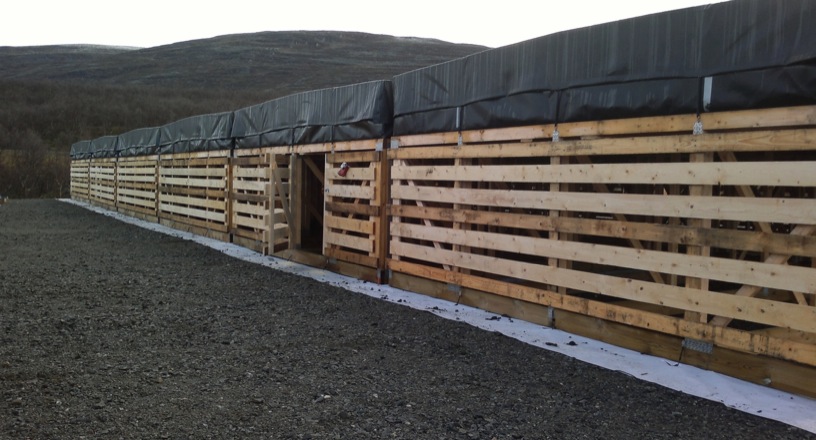
First of all, in order to prevent snow from blowing underneath the tiles, we converted the palettes used for transporting the HBA tiles into a snow fence. In the summer the snow fence will also prevent reindeer from walking under the tiles.

HBA palettes being converted into a snow fence. 

A small access door to allow 

Tuesday, 24 January 2012

KAIRA in January

Welcome back and welcome to a new year with the KAIRA project. To get the year started, we've a lovely image taken at midday on the 24th January 2012. Click on the image to see the full-sized version.


As you can see the snow lies deep across the site but the KAIRA HBA (and the distant Malla mountain) stand proud above the beautiful landscape.

For those who have been following the web log last year, you may notice a few new features in this photograph that you will not have seen before. Don't panic, you haven't missed anything. We've been so busy over the winter season that we've not had much chance to keep things up-to-date. However starting today we'll resume regular posts (every few days at first, then ramping up to full rate over the summer) as we enter another interesting year of construction, testing and the first scientific experiments.

Our plan is to catch up on the frantic work carried out prior to winter (yes, we'll rewind the clock a little bit to catch up on the story), with current news and events interspersed as we progress into the spring. Then, in the summer we'll be back in action as we start a second super-busy construction phase.

However for now we have just a nice image to show the site as it is around this time in the dead of winter. And from all of us here at the Sodankylä Geophysical Observatory, we extend to you all our good wishes for the new year. We've lots of exciting things to show you!


with best regards,
The KAIRA team.

Sunday, 11 December 2011

Faraday rotation from API echos

The enhanced echos produced by the API effect can also be used to measure Faraday rotation, i.e., the propagation time difference between the two characteristic modes of radio wave propagation, which is dependent on several plasma parameters, but most importantly electron density. The artificial periodic irregularities are useful here, as they allow us to get strong enhanced backscatter from this region, which would otherwise give such a strong return.

Here is our first Faraday-rotation measurement from API echos. This is still a fairly raw data product, which must be further inverted into an electron density profile.

Faraday rotation measured using enhanced ionospheric backscatter from heating induced artificial periodic irregularities. This allows us to measure small electron densities, which are otherwise difficult to measure. The delay between O and X modes of propagation is given in radians, as a fraction of a radar probing wave cycle.
More post to come, as we have one more week of measurements to go.

Saturday, 10 December 2011

Mesospheric velocities with API

One advantage of the API method is that it allows high resolution vertical velocities to be measured between 50-120 km. Here is an example plot from our 9.12.2011 measurement. Around noon (7000 seconds in to the measurement) there are also some tropospheric echos.

Vertical velocities in the 60-120 km region measured using the API method with the EISCAT heater. 

Thursday, 8 December 2011

API

This week me and Antti Kero are up in Tromsø doing artificial periodic irregularity (API) experiments with the EISCAT heater, which has recently been upgraded to include a radar receiver.

The idea with the experiments is to first produce a standing wave in the ionosphere, which heats up the plasma, and creates small enhancements of electron density at lambda/2 intervals. These irregularities are then probed with short radar pulses, which are used to probe the decay time of the irregularities. From this, it is possible to determine several ionospheric parameters: ionospheric chemistry, electron density, winds, and neutral density.

5.423 MHz X-mode API echo. There is also a meteor head echo accompanied with a decaying trail echo in this measurement.
We managed to actually get an API echo on our first try! Here is a picture from our second day of measurements. This is an API echo with 5.423 MHz at X-mode heating and probing polarization. We were also lucky to observe a meteor head echo and associated trail echo.