Showing posts with label EISCAT heater. Show all posts

Friday, 30 May 2014

Finnish EISCAT campaign, June 2014

A Finnish EISCAT campaign has been scheduled for June 4-10. The campaign objectives are:
  1. Heatncool - D-region ionospheric heating studies by Antti K
  2. Quadriphase-coded experiments - a continuation of the May 2014 campaign! Joint study by Lassi, Björn, Ilkka & Jussi. We also continue the USRP and EISCAT sampling studies, carried out also in May.
  3. TomoScand verification - Ionospheric tomography reconstructions with e-POP satellite mission, joint work with Lassi (SGO) and Johannes Norberg from Finnish Meteorological Institute and a number of collaborating partners from US and Canada, who are involved in the e-POP mission.
  4. EISCAT_3D receiver testing - the objective is to record EISCAT VHF long-pulse-coded experiments in Kilpisjärvi with KAIRA and new receiver technology developed by Siru, Codelma and RF-shamaanit.
Hence a multiobjective EISCAT campaign. I will travel up to Tromsø with Antti on Tuesday June 3 and head back to home around one week later. But in any case, we will try to arrive to Sodankylä prior the Midnight Sun Film Festival. A number of people will be at KAIRA site for all the campaign.

Thursday, 20 March 2014

Storm damage to the EISCAT Heating Facility

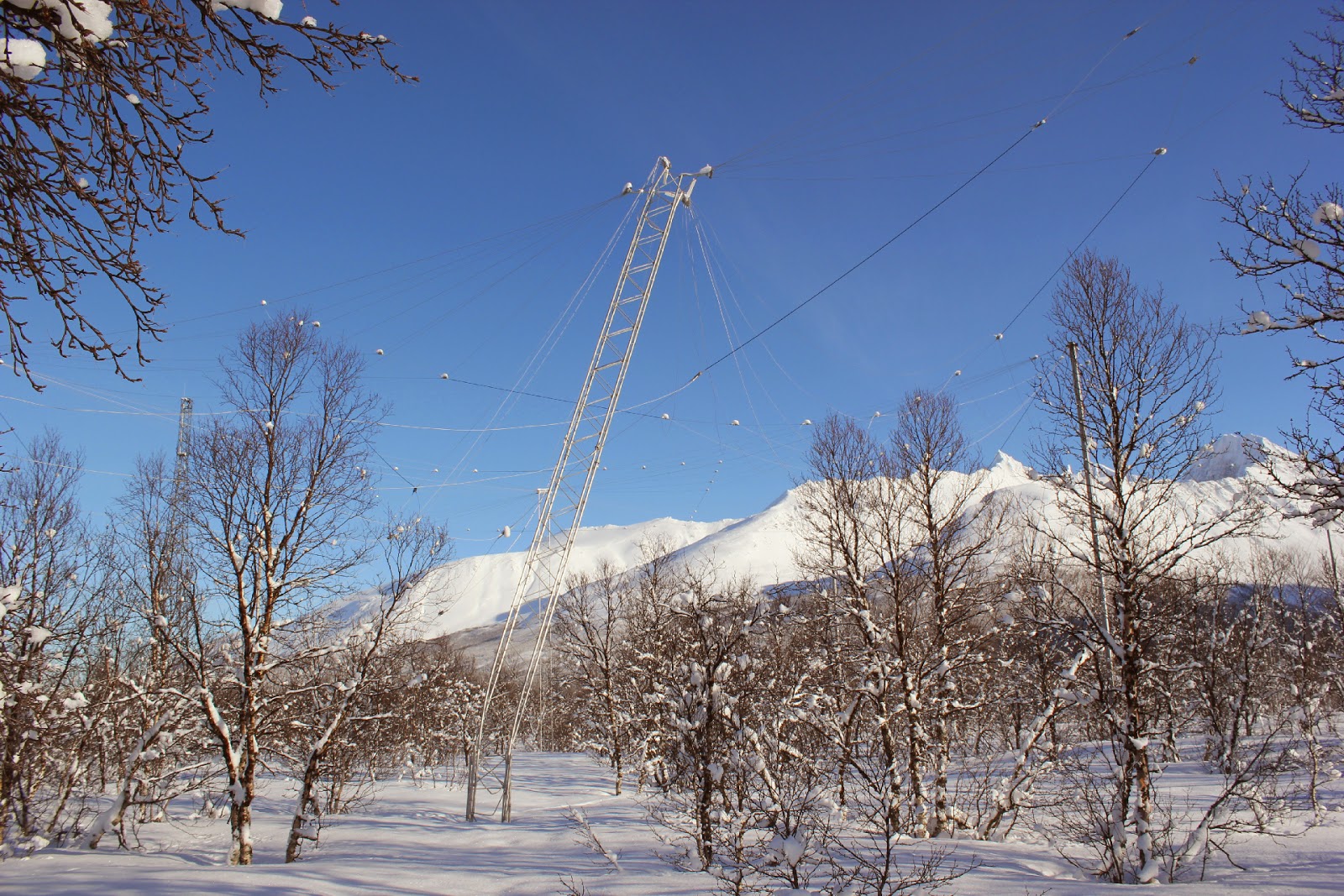
The storm that caused the KAIRA damage recently, probably also caused damage at the EISCAT site at Ramfjordmoen. This Heating antenna mast (which is also four coaxial feed lines) to tilt as one of the antenna-fixing wires broke.

The antenna was sound electrically on 23 February but was found faulty on 11 March, and a ski tour of inspection on sunny Sunday 16th March found this.


We suspect that the holding cable was also weak due to faulty construction about 30 years ago based on a similar failure once before in 1995, and that the extra forces from the wind finally broke the connection.


The second photo shows the broken insulating cable hanging from the wooden support mast. It will take some time to rebuild this. It means that two out of twelve Heating transmitters cannot be used on this low frequency (4-5.5 MHz) array until the summer.


Text and photographs by Mike Rietveld

Friday, 14 February 2014

Sunlit Hamperokken

It is Friday again, and we have a nice photograph to share with you today, submitted by one of our colleagues from the EISCAT facility, just up the road at Romfjordmoen, near Tromsø.

Hamperokken behind the wires of the ionospheric heating facility. (Photo: M. Rietveld)


The image shows the striking peak of 'Hamperokken' lit by the waning sun at 3.00 pm, Thursday 13 February, with some of the HF antennas of the ionospheric heating facility at Ramfjordmoen in the foreground. Taken while Mike Rietveld was digging about 1.5m into the crusty snow to fix some faulty coaxial cable feed lines in preparation for some Heating campaigns in the coming weeks. The unusually large snowfall and subsequent weather in November has caused considerable damage to the coaxial lines.

Thanks Mike for sharing this with us!

Have a good weekend, everyone.

Thursday, 8 December 2011

API

This week me and Antti Kero are up in Tromsø doing artificial periodic irregularity (API) experiments with the EISCAT heater, which has recently been upgraded to include a radar receiver.

The idea with the experiments is to first produce a standing wave in the ionosphere, which heats up the plasma, and creates small enhancements of electron density at lambda/2 intervals. These irregularities are then probed with short radar pulses, which are used to probe the decay time of the irregularities. From this, it is possible to determine several ionospheric parameters: ionospheric chemistry, electron density, winds, and neutral density.

5.423 MHz X-mode API echo. There is also a meteor head echo accompanied with a decaying trail echo in this measurement.
We managed to actually get an API echo on our first try! Here is a picture from our second day of measurements. This is an API echo with 5.423 MHz at X-mode heating and probing polarization. We were also lucky to observe a meteor head echo and associated trail echo.