Friday, 30 September 2011

LOFAR-UK observes the active sun

Over the last few days, our Sun has been very active. Apart from the dedicated solar instruments monitoring this activity, we've also been able to observe it with the LOFAR radio telescope at Chilbolton. This facility comprises two fields of small antennas, that link together to perform as a powerful VHF radio telescope. Although it is also possible to link the LOFAR system in the UK with others across Europe, on the 28th September 2011, it was operating independently.


At 16:10 UTC (= 5:10 pm local time), LOFAR Chilbolton was used to record an 'all-sky' image. Even before calibration and analysis, this image shows the bright objects in the radio sky. On the left-hand side of the image there are, from top to bottom, Cassiopeia-A (a supernova remnant), Cygnus-A (a radio-galaxy) and the broader region which is the centre of our own Galaxy. However, to the right of the image, the Sun can be seen with extremely strong intensity, just before it set below the western horizon.

The image shown was made using the UK608 LBA. It demonstrates what a LOFAR station is capable of, even when working alone and independent of the main International LOFAR network. The image is not calibrated nor cleaned in anyway. The observations were made by Menno Norden (ASTRON), and the report by Derek McKay-Bukowski (STFC).

The web release is also available from STFC's "RAL Space" website: http://www.stfc.ac.uk/RALSpace/Areas+of+expertise/Astronomy/LOFAR-UK/In+the+news/37611.aspx

Thursday, 29 September 2011

Updated Science Image

Today I updated the figure (on the right panel) that shows the different science cases that can be addressed with KAIRA. I have added two more cases: Relative TEC tomography, and tropospheric echos.

Relative TEC tomography involves several different LOFAR stations simultaneously measuring the total electron content, which is basically the difference in ionospheric propagation delay. Because LOFAR can do this with radio stars, in theory it should be possible to perform these kinds of measurements on a huge number of directions simultaneously. This is a huge advantage compared to satellite tomography, which can only measure the total electron content between ground based stations and satellites. This large number of rays might make it possible to do extremely high resolution 3D ionospheric tomography with LOFAR. Currently the best location for doing this would be near the core of the array, where there are many stations located nearby.

The tropospheric echo science case was added after discussions with Ingemar Häggström of EISCAT, who told me that he often sees tropospheric echos in Kiruna, both from the VHF and UHF. With multistatic receivers, this would potentially allow tropospheric wind and scattering spectrum measurements.

Wednesday, 21 September 2011

HBA Rack installation

Last week Peter Gruppen ja Jan-Pieter de Reijer from ASTRON came by, and did the cabling work and receiver rack installation at the KAIRA site.


The HBA cables going into the digital receivers. 

Beamformer cables going into the switch. 


 Now if we could just get summators (which are in short supply right now) before snowfall, we could start measuring. 

Tuesday, 20 September 2011

LBA protype v 2.0

LBA platform version 2.0. Photo: Markku Postila
Here is another prototype of the raised LBA antenna platform designed by Markku Postila and Toivi Iinatti. This one allows arbitrary rotation of the antenna and has easily adjustable legs. The picture also shows the LBA antenna installed on top of the platform.

However, it seems that we will need to extend the ground plane with this type of a design. Recent antenna modeling results by Johan Borg of LTU suggests that this configuration has the effect of broadening of beam significantly at higher frequencies.

NEC model of the antenna with a raised ground sheet.
40 MHz beam pattern of an individual element. Slight broadening at 40 MHz, but nothing too serious.

80 MHz beam pattern of an individual element. The raised platform causes a broadening of the beam and a deeper minima at the zenith.

Thursday, 15 September 2011

Optical fiber

Laying the last meter of fiber to the RF container. Photo: Markku Postila.
Yesterday there was good news, and some bad news. First of all, the fiber cabling work has now been completed. Whenever we want to, we can start using the internet over fiber cable! However, in terms of bad news, we didn't get any summators, and we are thus not able to start using the antenna yet. There seems to be some kind of a problem with the production of the summators, and nobody knows of a delivery date. If this is delayed a month more, it will be too cold and snowy to install them this winter, and we will have to wait for next summer before we can measure with the system.

Wednesday, 14 September 2011

TEC Measurements with LOFAR

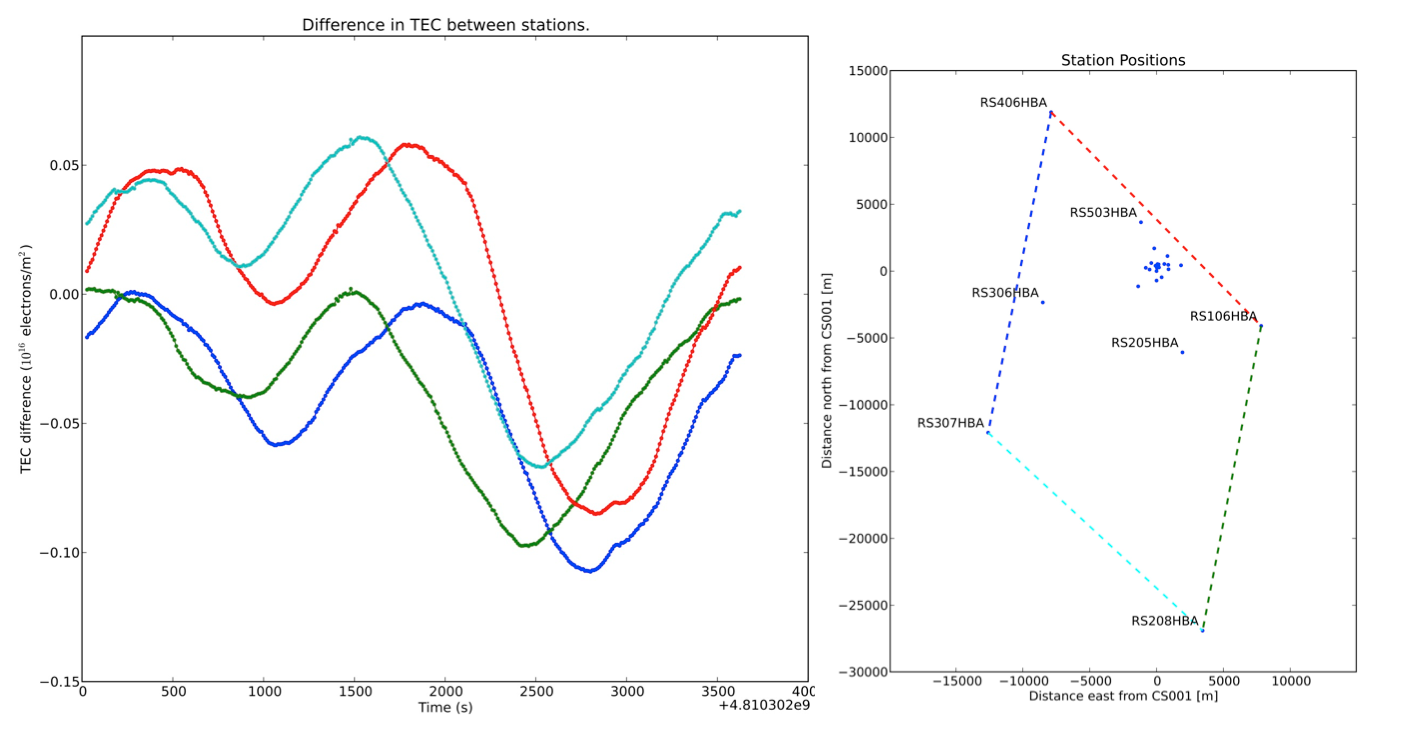
TEC Measurements with LOFAR. Copyright: Mark Aartsen. 
Today the ASTRON daily image featured a very interesting image in terms of geophysics. It featured a total electron content measurement produced by listening to a strong radio source using four different stations. This is interesting because if one can produce such measurements using many different radio sources, it would be possible to use this for three dimensional ionospheric tomography. 

Tuesday, 13 September 2011

LBA Prototype platform

The LBA platform prototype, built by Markku Postila and Toivi Iinatti. 
We are now already thinking about the LBA build next year. This will be challenging because we cannot level the field, as it will probably cause erosion and water quality problems with the nearby Siilasjärvi lake, were all the water drains to. We are now focusing on a design which involves similar raised platforms, which hopefully will allow easy position adjustments, when permafrost moves our antennas around. Another reason for the platform is that we will need to use them in order to level out the antennas, if we cannot level out the ground. In anticipation of this, Johan Borg of LTU is currently investigating the effect of such a platform on the beam pattern of an individual antenna.