Showing posts with label sun. Show all posts

Saturday, 21 June 2014

Midnight solar flare

Around this time of year, we have the midnight sun and one very long day! The midnight sun is nicely viewed from KAIRA and it is always calm and peaceful. Of course that's not always the case at the sun itself.

A few weeks back we caught a solar flare very close to the local solar midnight. Due to the equation of time, the application of daylight-savings/summer time in Europe, and our location, the minimum elevation of the Sun is not exactly at clock midnight.

However, very close to the point of minimum elevation (and the Sun crossing the northen meridian), KAIRA caught this solar flare.

Midnight solar flare! (Image: D. McKay-Bukowski)


Given that the elevation of the sun was quite low (approx. +2 degrees), this must have been a bright flare!

Our northern summer solstice occurs at 10:51 UTC on 21 June 2014.

Friday, 20 June 2014

Midnight sun

Today we just have a nice photograph of the midnight sun taken from KAIRA.

Midnight sun seen from KAIRA (Photo: D. McKay-Bukowski)

Wednesday, 11 June 2014

Double-X-flare

Yesterday morning we were meant to do incoherent scatter radar (ISR) observations of the EISCAT VHF. This was in conjunction with a demonstration/prototype system that is also being tested at the KAIRA site (more on this in a forthcoming article!). Then, in the afternoon, we'd revert to solar observing.

However, due to various issues we ended up postponing the VHF ISR observations to the afternoon. Sure enough during that time there was two X-class solar flares. Yep, not one, but two. After months of radio silence what there the chances (pretty good, it seems!).


In any case we were observing nonetheless and there was a chance we might have seen something in the sidelobes of the tile beams. Sure enough there were several hints of natural emission, which may be from the sun.


Monday, 26 May 2014

Solar observing over the weekend

Over the weekend, KAIRA was conducting some more solar observing. We were trying out some new data acquisition modes, software and schedules. The sun was moderately active, which was good.


However, we were struck by some serious storms on the Friday night, which caused no end of problems. I suspect that things might still require attention and we will be looking into that today.

Sunday, 25 May 2014

Summer sun

We are now within a month of mid-summer and the days are pretty much continuous now. The skies have been pretty grey, but they did open up yesterday to give a lovely burst of light and warmth.

Summer sun through the forest near Orajärvi. (Photo: D. McKay-Bukowski)

There's solar observing going on at KAIRA at the moment. I wonder how it's going?

Monday, 19 May 2014

Further investigations on the strange solar ripple

We've been following the progress on trying to understand a strange ripple in some recent solar observations.


As each antenna has two polarisations, we plot first the X-polarisation and the Y-polarisation. They are done separately, to avoid a strong flickering effect (which is due to the different responses to the event between the two polarisations).

The "RCU" number is the Reciever Unit number. The even RCUs are for the X-polarisation and the odd ones are for the Y-polarisation. Three RCUs have been omitted (68,69, and 70) as these were offline at the time the observations were made.

Actually, we noticed that they oscillate. The oscillation is small to start with and then it increases. The movement is small, but those fringes waver with RCU number.


RCU number is a function of the antenna number.

   RCU 0,1 = LBA #L00
   RCU 2,3 = LBA #L01  
       :
       :
   RCU 94,95 = LBA #L47

And, if you look at the map of the array, and join the dots in numeric order, you get this:


So, then what I did was to look for where the minimum fringes and maximum fringes occur. In other words, as the pattern moves up and down, what are the local min/max points in that oscillation.

I noted the RCU numbers, determined the antenna numbers and plotted them. I also note the direction of the sun during this time (roughly).


This tells as that the fringe pattern is associated with distance from the sun. Well, it is not likely to be that directly, but because there is a mound with the LBAs, there will be more flat ground between #L43 and the sun than #L35. This snow/ground could be causing reflections.

What these results tell us, though, is that the original hypothesis of a reflection off the reindeer fence or gate is actually pretty unlikely.

So there are now two likes of thought. One is that this is a snow effect and some modelling is going on to investigate this.

The other is that it is an ionospheric refraction effect.

Neither idea is firm yet and investigations remain ongoing.

Monday, 5 May 2014

Curious ripple in the data

The strange ripple in the dynamic spectrum of the solar radio event from a few weeks back has caught some interest, and we don't have an explanation for it... yet. At first, it was thought it might be an RFI effect, although it is very broad. It also drifts in frequency, which is unusual.

These data are from a single dipole. So, it might be coupling between that and other dipoles, or perhaps Cas A rippling through a sidelobe. For the UK station (which doesn't see the effect -- REF), these sources would be at different position angles. There are several things we have now checked:

We see it on different dipoles. These might have different couplings (due to antenna spacings) or be at different position angles (with respect to, say, a local RFI source).

We also see it on both polarisations. The following two plots are from different polarisations.

LBA aerial #L04, X-polarisation (Image: D. McKay-Bukowski)

LBA aerial #L04, Y-polarisation (Image: D. McKay-Bukowski)


We may still be seeing some sort of ground effect or perhaps a reflection from the reindeer fence. Alternatively, it might be a "snow interferometer" (like the old sea-interferometer, but with a reflection off the snow). The fact is that the sun is at quite a low elevation and the wavelengths are quite long at these frequency bands.

In any case, we remain puzzled. Any suggestions, anyone?

Monday, 28 April 2014

Comparing solar data

Last week, we reported on a spectacular solar event that we caught with KAIRA. As it turned out, the LOFAR station in England (UK608 Chilbolton) also caught the event, although only part of it.

Today, we have the data for the event as seen from both stations. Although we have a lot more KAIRA data, we have clipped it to make it match the same time range as the UK608 data.


Although very similar, there are some differences between the two stations. KAIRA's layout (REF) is different to that of the layout of UK608 (REF) and the UK station has twice the number of aerials. At the time of the measurement some of the KAIRA aerials were still out of action, due to the storm damage.

The stations are also at a different latitudes/longitudes. Therefore the relative topocentric position of the sun with respect to the two arrays is different. Certainly at KAIRA, the sun is lower in the sky. This also affects the relative position with respect to the polarisation orientation of the aerials (although the sun is largely unpolarised, the aerials do have a different response as we are only using one dipole for these measurements).

Finally, the radio-frequency interference (RFI) environments are slightly different between the two stations.

Monday, 21 April 2014

Spectacular solar radio event

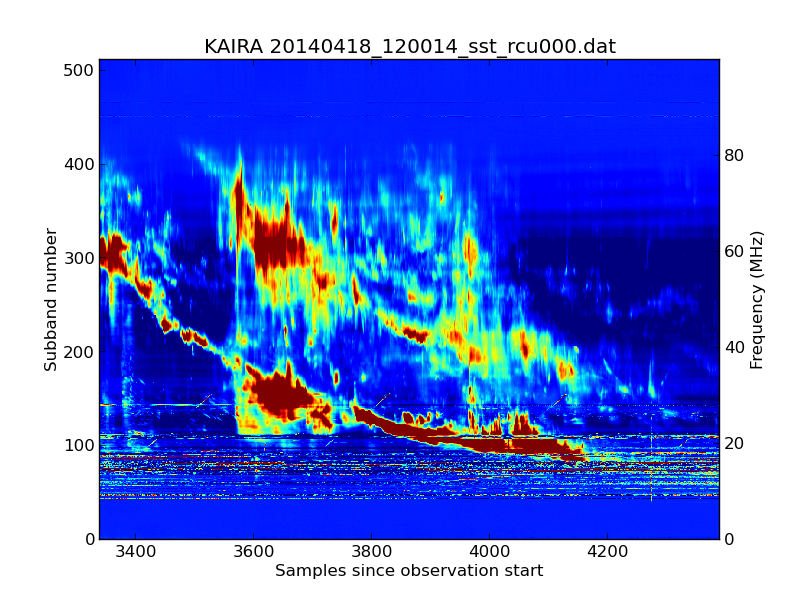
Last Friday, KAIRA observed the most amazing radio event from the sun. There was a strong X-ray event, which corresponded to an amazing multi-frequency solar event in the radio. The following plot is from the GOES X-ray monitor (source: NOAA/SWPC)


The event was detected at KAIRA and the following plot shows the entire event sequence.

KAIRA detecting of the solar radio event (Image: D. McKay-Bukowski)

The initial event was preceded by a smaller, fainter event. However the first of the strong radio bursts was very strong and mostly uniform in frequency distribution.

Zooming in on the initial event (Image: D. McKay-Bukowski)

 The subsequent events were much more complicated. In particular, there was a very slowly decaying radio event, which cascaded down through the different frequencies of the Low-Band Array (which was operating at the time).

The main event... very complex! (Image: D. McKay-Bukowski)

What is really curious is the ripple effect through the different frequencies. Is this an interferometric effect from the coupling between antennas? However, these data were taken with a single LBA aerial.

It will be interesting to see what auroral activity occurs over the next few days. Although it is getting close to the midnight-sun season, KAIRA will be able to monitor the events using the new riometry modes.

Overall it was a very interesting event. We will be conducting a number of dedicated solar observing events over the summer with KAIRA, so hope to report on more solar data in the next few months.

Wednesday, 26 March 2014

Radio bright sun -- Part 2

Yesterday we showed some KAIRA data of a very active sun. It was so bright that it easily outshone Cas A and Cyg A. Given this, we surmised it should be possible to see the solar signal with a single dipole.

Sure enough, that was the case.

The following plot shows the subband statistics for a single antenna (LBA aerial #45, Y-polarisation).


The vertical axis is frequency, shown as both the subband number (left-hand side) and frequency in MHz (right-hand side). The broad band of noise between 8 and 25 MHz (approx.) are the sum of countless shortwave radio transmissions. Below 8 MHz and about 80 MHz, there is little signal due to the LOFAR RFI suppression filters and the weaker amplifier and aerial responses.

Tuesday, 25 March 2014

Radio bright sun

On 20 March 2014, the Sun was particularly active. As it passed over the southern horizon, KAIRA detected strong radio emission. We had the station correlator running at the time and managed to capture this all-sky image sequence.


The video covers the period from approx. 10:05 until 10:15 UTC. Each frame is a 1-second integration, however it has been sped up to reduce the duration. The date/time (UTC) is shown in the filename at the top-left of the image sequence. The observing frequency is subband 300 (= approx. 58.6 MHz, with 195 kHz bandwidth).

The object near the centre of the image is Cas A and to its right is Cyg A. These are normally very bright radio sources. However, the sun (on the lower edge) easily outshines them... especially around 10:09 UTC (about 0:24 in the video). For the purposes of making this sequence, we really had to turn down the contrast to prevent complete saturation.

When the sun is radio-bright, strange artefacts can be seen in other parts of the image. These are the "sidelobe" responses of the telescope and are not real sources.

It says something about the strength of the solar radio bursts, when the sidelobe response can outshine even Cas A!

Friday, 21 February 2014

Sunshine!

Yesterday we had some sunshine at the institute. This is actually quite unusual for this year as, apart from the darkness, it has been cloudy nearly no stop since October. So, a bit of sunshine features as today's Friday photograph. The photo was taken by Lassi in the early afternoon.


Sunshine at the EISCAT Building and 32m antenna. (Photo: L. Roininen)

Have a nice weekend!

Wednesday, 29 January 2014

Sunshine

This might seem really dull, but for us at this time of year, the rays of sunshine are very gratifying... especially after the dark and cold. Of course, it is still bitterly cold here, but sunshine on the snow is very pretty (although it can be a bit blinding at times too).

After kaamos and lots of cloudy weather, a brief clear spell let
the sunshine glance the treetops. (Photo: D. McKay-Bukowski)


Monday, 27 January 2014

Frozen river

Today's photograph is from Sodankylä. It was taken from the bridge over the Kitinen River, looking southwards. At this time of the year, the river is frozen and it serves as a "road" for the snowmobile traffic. You can see the tracks in the snow on the frozen river surface.

Kitinen River, seen from the bridge at Sodankylä (Photo: D. McKay-Bukowski)

Notice how high the midday sun is now. It is lovely to have those few hours of sunshine. After the kaamos, one really appreciates the glimmers of sun light.

Monday, 13 January 2014

Glimmer of sunlight

Yesterday I caught a glimmer of sunlight. With kaamos and the overcast skies, this has been the first hint of sunshine for 2014. Admitedly it was not direct sunlight into my own eyes, but it was definitely striking the 32m EISCAT dish at Sodankylä.

A hint of sunlight on the EISCAT 32m dish at SGO. (Photo: D. McKay-Bukowski)

Monday, 9 December 2013

Heatwave predicted

Weather alert for Sodankylä! There is a major heat wave predicted for Thursday. The temperature is expected to soar by over 30 deg C above the current temperatures. In fact, it may even go into the positives on Thursday!


I wonder if we can expect ice cream, barbecues, and people sunning themselves in their swimwear on the river bank. After all the sun will graze above the horizon for an hour or so at Sodankylä, which is not yet in kaamos.

Sunday, 1 December 2013

Kaamos

Polar Night (Finnish = kaamos) is the time of the year when the Sun does not rise above the horizon at any point during the day. Kilpisjärvi is now in Polar Night. Although it might seem that this means that the place is pitch dark all the time, this is actually not true.

Close to midday, the Sun may still be below the horizon, however, it does get quite close to it. During this time, the light levels rise to a twilight before sinking back into darkness again.

Midday on 30-Nov-2013 at KAIRA. (Photo: D. McKay-Bukowski)
In fact only within a five or so degrees of the poles will the location remain in total darkness for more than 24 hours. Astronomical twilight begins when the Sun rises above 18 degrees below the horizon.

Despite the midnight sun in Summer and huge spans of twiilight, the sun never rises particularly high and so the incident light and warmth remains marginal... hence the cooler temperatures.

Friday, 15 November 2013

Sun and cloud

Just a nice photograph for Friday.

Sunshine setting the clouds afire. (Photo: D. McKay-Bukowski)

Have a nice weekend!

Sunday, 10 November 2013

Fiery skies

Today's photograph is from a little while ago now. It was perhaps the last day before the snow started, and there was a particularly spectacular sunrise. In amongst the clouds is the faint silhouette of Saana.

A fiery sunrise over the KAIRA LBA (Photo: D. McKay-Bukowski)

Tuesday, 5 November 2013

Floating at the top of the world

Today we have a nice photograph of the midday sun over the KAIRA site. There is not much sun left now, with Polar Night about to start. So we're going to make the most of it!

Sun and clouds over the KAIRA site. (Photo: D. McKay-Bukowski)

The clouds make it seem like the entire observatory is floating at 10 000 m above sea level!