 |
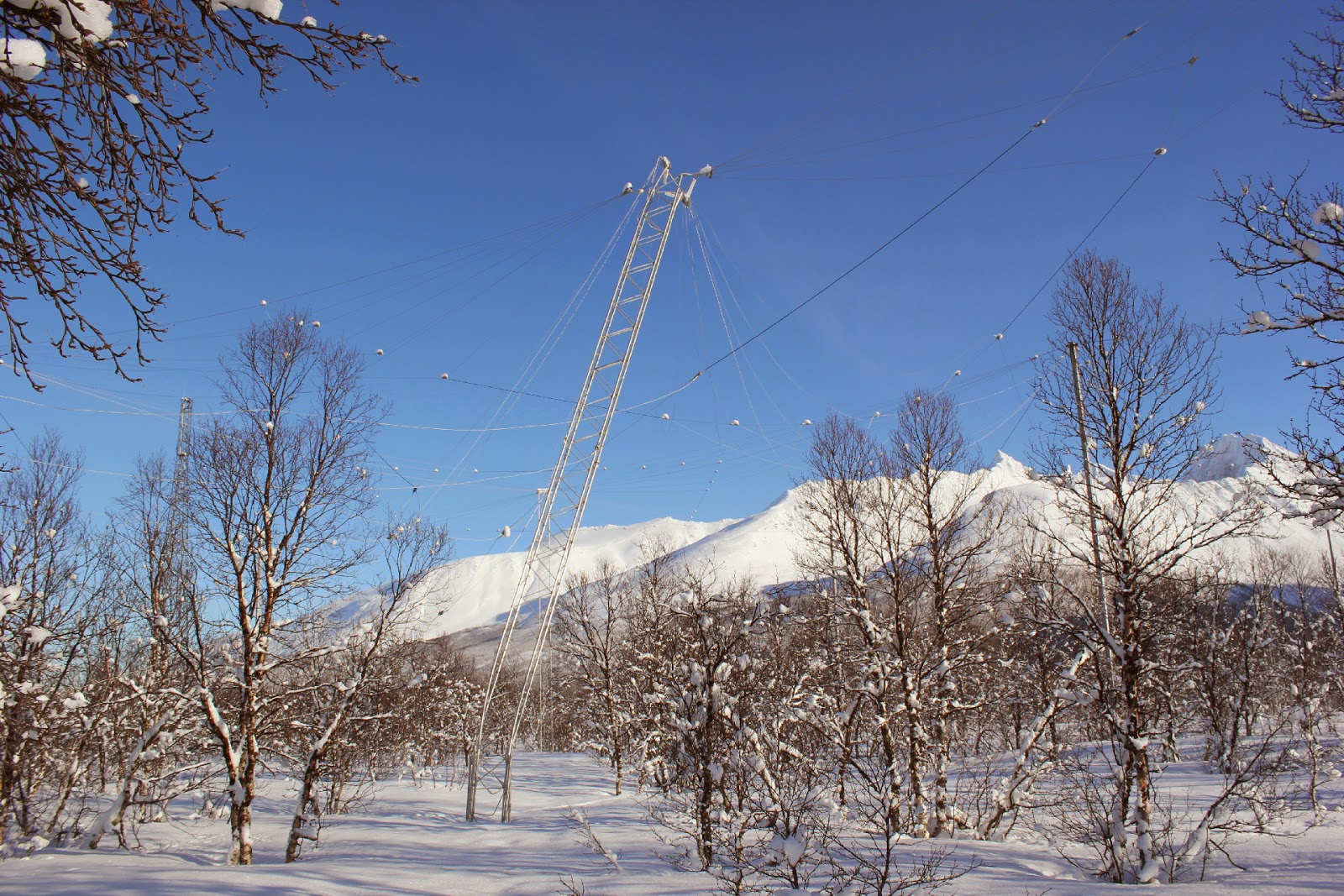
| Frameset for HBA tile #75 (D. McKay-Bukowski) |

Showing posts with label blizzard2014. Show all posts
Showing posts with label blizzard2014. Show all posts
Sunday, 24 August 2014
Missing in action
Today's photograph shows the frameset of HBA tile #75. Or, we should say... the former HBA tile #75. It is missing due to a severe blizzard that swept through the site at the beginning of the year. We are still waiting for a quote from ASTRON to get this replaced.

Wednesday, 2 July 2014
Securing the LBA
We attempted to effect repairs on the KAIRA LBA, but we were short of some parts (cable connectors), which meant that some aerials needed to remain down. In order to ensure that the existing parts were secure, we used tape and rocks to prop up the posts and permit water drainage. It looks a little odd, but it works!
At present, we have 1 tile and 4 aerials out of action. We hope to repair the LBAs in July/August and we are waiting on a quote from ASTRON for a replacement tile.
 |
| The few remaining damaged LBA aerials (Photo: D. McKay-Bukowski) |
At present, we have 1 tile and 4 aerials out of action. We hope to repair the LBAs in July/August and we are waiting on a quote from ASTRON for a replacement tile.
Tuesday, 1 July 2014
Fixing HBA damage
In March we lost one HBA tile and had several others damaged by the blizzard. Last week we repaired one of the more badly damaged tiles, replacing shattered polystyrene parts and re-securing the cover.
 |
| Assessing H65 (Photo: D. McKay-Bukowski) |
 |
| Internal damage on HBA H65 (Photo: D. McKay-Bukowski) |
Friday, 6 June 2014
More storm damage revealed
As the snow recedes we are find more and more horrors from the great blizzard of 2014. In addition to destroyed fencing etc., there appears to be a lot of array damage that was hitherto hidden. Perhaps the most surprising was finding a broken staafje (a small white fibreglass rod that joins the S-haakje to the HBA tile cover. The fact that this broke is pretty amazing as they are very strong.
 |
| Collapsed cell in Tile H65. (Photo: D. McKay-Bukowski) |
 |
| Broken staafje(!) and S-haakje. (Photo: D. McKay-Bukowski) |
 |
| Shattered frame on the LBA cable mausoleum. (Photo: D. McKay-Bukowski) |
 |
| Collapsed LBA aerial #L05. (Photo: D. McKay-Bukowski) |
 |
| Destroyed LBA aerial #L34. (Photo: D. McKay-Bukowski) |
Wednesday, 4 June 2014
Snow situation at KAIRA
Hey! We're back on site again. Normally a very joyful occasion (this is, after all, the coolest LOFAR site on the planet), however this time it was marred by the fact that the receding snow is showing up more and more damage from the great blizzard of 2014.
Still, there is a quite a lot of snow to been seen, as these photographs show (taken on the evening of 02-Jun-2014).
Fortunately, with this quantity of snow, there are no mosquitoes... yet.
Still, there is a quite a lot of snow to been seen, as these photographs show (taken on the evening of 02-Jun-2014).
 |
| Snow banks along the storage containers. These are over 1,5m tall in places. (Photo: D. McKay-Bukowski) |
 |
| Looking out over the lower field. Rivulets of water are everywhere now. (Photo: D. McKay-Bukowski) |
 |
| The gully behind the barracks. (Photo: D. McKay-Bukowski) |
Fortunately, with this quantity of snow, there are no mosquitoes... yet.
Saturday, 29 March 2014
The remains
Following the great Kilpisjärvi Storm of 2014, the telescope rescue crew scoured the surrounding landscape trying to find and recover debris. Part of this was recovering as much scattered electronics as possible... some of which may be able to be cleaned up and re-used as spares.
This sad crate of fragments are some of the parts salvaged during that operation. (Click on the photograph to enlarge.)
This sad crate of fragments are some of the parts salvaged during that operation. (Click on the photograph to enlarge.)
 |
| Salvaged parts from the destroyed LOFAR HBA tile at KAIRA. (Photo: L. Roininen) |
Thursday, 27 March 2014
JIVE ASTRON Daily Image -- Storm Report
For those who didn't see it, KAIRA was featured yesterday on the JIVE/ASTRON Daily Image. This long-running web-log features images and news from these two organisations. As KAIRA is built of LOFAR technology, which is from ASTRON, and yours truly used to work for JIVE, we have always been keen to support their long-running outreach efforts. And yes, it is always fun to get an article posted there!
Yesterday's article was about the recent storm damage. For those who follow the KAIRA web log, this will be nothing new, as we've covered the topic in detail here. However, we did put together a nice montage and we have that here today.

However, the JIVE/ASTRON Daily Image article does provide a great summary of the recent problems (and solutions!), so go check it out if you haven't already done so.
Direct link: http://www.astron.nl/dailyimage/main.php?date=20140326
Yesterday's article was about the recent storm damage. For those who follow the KAIRA web log, this will be nothing new, as we've covered the topic in detail here. However, we did put together a nice montage and we have that here today.
However, the JIVE/ASTRON Daily Image article does provide a great summary of the recent problems (and solutions!), so go check it out if you haven't already done so.
Direct link: http://www.astron.nl/dailyimage/main.php?date=20140326
Friday, 21 March 2014
Storm damage at MAARSY
Ralph Latteck from IAP sent me some pictures of the damage at MAARSY caused by the same winter storm that disintegrated one of KAIRA's HBA tiles and fell down an antenna mast of the EISCAT Tromsø ionospheric heater.
Even though MAARSY is right by the seaside in Andoya, it survived the storm with only minor scratches. The main damage was in the form of twisted cable trays and a few bent antenna elements. While the some of the cable trays look pretty mangled, only a few of the cables feeding the antennas were severed, allowing the radar to continue operations pretty much normally. Good thing that the antennas were fairly rugged and firmly weighed down with slabs of concrete.
 |
| One mangled cable tray. The picture also shows the new configuration of the array with the dual polarization capability. This is helpful when observing the ionosphere, where the 53.5 MHz radio wave experiences significant Faraday rotation. |
 |
| The worst of the damage. The cable trays have caught some wind, causing two antenna elements to bend out of shape. |
This was also a reminder for me that I should write a posting about MAARSY at some point. It is truly a remarkable instrument. Not only is it a state of the art instrument for observing the mesosphere, stratosphere, and troposphere, it can also be used to observe meteors and the ionosphere.
Thursday, 20 March 2014
Storm damage to the EISCAT Heating Facility
The storm that caused the KAIRA damage recently, probably also caused
damage at the EISCAT site at Ramfjordmoen. This Heating antenna mast (which is also four coaxial feed lines) to
tilt as one of the antenna-fixing wires broke.
The antenna was sound electrically on 23 February but was found faulty on 11 March, and a ski tour of inspection on sunny Sunday 16th March found this.
We suspect that the holding cable was also weak due to faulty construction about 30 years ago based on a similar failure once before in 1995, and that the extra forces from the wind finally broke the connection.

The second photo shows the broken insulating cable hanging from the wooden support mast. It will take some time to rebuild this. It means that two out of twelve Heating transmitters cannot be used on this low frequency (4-5.5 MHz) array until the summer.
Text and photographs by Mike Rietveld
The antenna was sound electrically on 23 February but was found faulty on 11 March, and a ski tour of inspection on sunny Sunday 16th March found this.
We suspect that the holding cable was also weak due to faulty construction about 30 years ago based on a similar failure once before in 1995, and that the extra forces from the wind finally broke the connection.
The second photo shows the broken insulating cable hanging from the wooden support mast. It will take some time to rebuild this. It means that two out of twelve Heating transmitters cannot be used on this low frequency (4-5.5 MHz) array until the summer.
Text and photographs by Mike Rietveld
Sunday, 16 March 2014
Map of the 2014 KAIRA storm damage
Today, we've plotted where there has been damage to KAIRA. The map is a bit scary, but actually as we have seen from yesterday things are not so bad and we've come out of it fairly well.
 As can be seen, we have lost two antennas completely. These are tile #H75 and aerial #L34.
We've had two aerials (#L05 and #L21) seriously damaged. These will need to be replaced.
There are three aerials (#L22, #L35 and #L36) which have been damaged but have been repaired to the point where they are operating normally again. However additional work will be required in the summer when the snow has melted and we can access them properly.
There are many aerials with minor damage. The aerials are still operational, but will require some attention in the summer to ensure they remain robust for the following winter. The problem has been buffeting to the aerial wires causing cracks in the PVC moulding and coatings. These can be patched, but it does require warmer weather.
Saturday, 15 March 2014
System status
Following the storm and the repair work, we carried out remote system checks for the bandpasses for all antennas. Here are the results, starting with the High-Band Antenna (HBA) array:

As seen, RCUs 80 and 81 (= tile #H75) remain dead. These are the two channels from this destroyed tile.
Here is the Low-Band Antenna (LBA) array results:

Here you can see RCUs 68 and 69 (= aerial #34) remain dead. This aerial was destroyed and we have not even found the remains of it! Following repairs, there remain two other damaged signal channels. These are RCU 11 (= aerial #L05, Y-polarisation) and RCU 42 (= aerial #L21, X-polarisation). These two aerials have suffered broken wires and are thus impared in this polarisation. Temporary repairs have been effected, but more work remains to be done.
However, in total, we only have lost 6 out of 192 signal channels. Throughout the storm and the repair work, KAIRA has continued to observe our riometry and interferometry programmes. That's pretty good.
As seen, RCUs 80 and 81 (= tile #H75) remain dead. These are the two channels from this destroyed tile.
Here is the Low-Band Antenna (LBA) array results:
Here you can see RCUs 68 and 69 (= aerial #34) remain dead. This aerial was destroyed and we have not even found the remains of it! Following repairs, there remain two other damaged signal channels. These are RCU 11 (= aerial #L05, Y-polarisation) and RCU 42 (= aerial #L21, X-polarisation). These two aerials have suffered broken wires and are thus impared in this polarisation. Temporary repairs have been effected, but more work remains to be done.
However, in total, we only have lost 6 out of 192 signal channels. Throughout the storm and the repair work, KAIRA has continued to observe our riometry and interferometry programmes. That's pretty good.
Friday, 14 March 2014
What a week!
It has been a nerving week with all the KAIRA storm damages! Fortunately, most of the site has survived and we can continue operations! The damaged aerials and the destroyed HBA panel will be serviced or replaced during the coming weeks or next summer!
Hence, even though we had bad luck, we are very happy to see that KAIRA is back in business!
Have a nice weekend! ... and let's hope that there won't be another storm on Saturday :) !!!
Hence, even though we had bad luck, we are very happy to see that KAIRA is back in business!
Have a nice weekend! ... and let's hope that there won't be another storm on Saturday :) !!!
 |
| Thursday morning photo - service operations in progress! |
Thursday, 13 March 2014
Day 2: Robust fixes - storm repairs
Our team in Kilpisjärvi had a long day in the KAIRA site on Thursday fixing bits and pieces here and there. The repairs, maybe not elegant, but they are robust and should give us time to plan a full-scale repair operations in the site! We let the photos to speak for themselves! ... And of course - many thanks to all the staff up in Kilpisjärvi!
We will post more pics in the coming days!


We will post more pics in the coming days!
Correlating gusts and failures
From the last few days, we've been looking at the loss of signal from the LBA aerial #L34 and today we've correlated that with the wind-gust speeds. Although the average speed is often of interest, it is the gusts that usually determine points of failure or direct damage.
In the graph we have plotted the 10-minute gust maxima for Kilpisjärvi village and Saana mountain (the two nearest official weather stations to KAIRA). Also plotted is a vertical line showing the point at which signal was suddenly lost from LBA aerial #L34.

Not surprisingly, it corresponds to a strong peak. However it is good to note that we tolerated up to that value and that the failure did not occur earlier at lower gust speeds.
The failure time is slightly ahead of the peak. This also not surprising, as the weather stations were both downwind of the KAIRA site (by a few km) at the time of the failure.
Data courtesy from the Finnish Meteorological Institute (www.fmi.fi)
In the graph we have plotted the 10-minute gust maxima for Kilpisjärvi village and Saana mountain (the two nearest official weather stations to KAIRA). Also plotted is a vertical line showing the point at which signal was suddenly lost from LBA aerial #L34.
Not surprisingly, it corresponds to a strong peak. However it is good to note that we tolerated up to that value and that the failure did not occur earlier at lower gust speeds.
The failure time is slightly ahead of the peak. This also not surprising, as the weather stations were both downwind of the KAIRA site (by a few km) at the time of the failure.
Data courtesy from the Finnish Meteorological Institute (www.fmi.fi)
Wednesday, 12 March 2014
KAIRA storm damage repairs - Day 1
A three-person SGO team travelled up to Kilpisjärvi today. They have investigated the storm damages as well as the protection cover constructed by local craftsmen on Monday. The cover is of good quality and seems to protect the HBA field fully, despite we have one HBA tile totally destroyed.
The LBA field has been damaged during the storm. We suspect that this is due to the HBA debris which has flown through the LBA field. Altogether around 8 antennas require different levels of maintenance. One antenna is flat-lining!
Below are a set of photos from the Day 1 of the SGO team damage inspection and emergency repair expedition! The weather is continuing to be challenging in Kilpisjärvi! Despite of that, our courageous team is doing their best with the repairs!
Good work chaps! … and good luck for Thursday!


Moment of death
We trawled back through the subband statistics (SST) data to find the exact instant that LBA aerial #L34 was destroyed. The critical moment seemed to be around 18:50:20 UTC.

As can be seen, there is a possible preliminary event some 12 seconds earlier. Not sure what this could have been. Flying debris, perhaps?
In any case, this was the point when we lost aerial #L34, which probably was due to flying debris from tile #H75.
As can be seen, there is a possible preliminary event some 12 seconds earlier. Not sure what this could have been. Flying debris, perhaps?
In any case, this was the point when we lost aerial #L34, which probably was due to flying debris from tile #H75.
Tuesday, 11 March 2014
It was a hurricane-force storm!
In order to analyse the causes of damages at KAIRA, we need to see the wind directions and wind speeds during the storm. Here are the FMI 10 minute averages from the Kilpisjärvi village and Saana top. It was indeed a hurricane-force storm in the Beaufort scale!

LBA aerial problems
Along similar lines to yesterday's web log report, we've also carried out tests for all the aerials of the Low-Band Array (LBA). Here, we also have problems, although the situation is more complicated. Like yesterday, we shall start with a plot of all subbands for all RCUs configured for the LBA aerials.

As can be seen, there are a number which show abnormalities. Most of these are suppressed signals, sometimes causing a shift in the peak amplifier response frequency. This is likely to be caused by snow, as seen in one of our previous reports.
However, the effect on RCUs 68 and 69 is more serious. This looks like a destroyed aerial.
If we plot these onto a map of the array, the positions of the affected aerials are as follows:

One thing to note is that the signal processing chains can be cleared of any faults. The problem with the HBA was on RCUs 80 and 81, but this was absolutely fine for the LBA. The same applies the other way; for example, RCUs 68 and 69 are down here, but were okay on the HBA.
What needs to be done now is to evaluate the situation, especially with aerial #34.
As can be seen, there are a number which show abnormalities. Most of these are suppressed signals, sometimes causing a shift in the peak amplifier response frequency. This is likely to be caused by snow, as seen in one of our previous reports.
However, the effect on RCUs 68 and 69 is more serious. This looks like a destroyed aerial.
If we plot these onto a map of the array, the positions of the affected aerials are as follows:
One thing to note is that the signal processing chains can be cleared of any faults. The problem with the HBA was on RCUs 80 and 81, but this was absolutely fine for the LBA. The same applies the other way; for example, RCUs 68 and 69 are down here, but were okay on the HBA.
What needs to be done now is to evaluate the situation, especially with aerial #34.
Subscribe to:
Posts (Atom)