Thursday, 17 May 2012

I-LOFAR castle reception

Here is some more news from the recent I-LOFAR meeting. On the first day there, there was a reception in the Castle. The 7th Earl of Rosse, and current occupant of the castle, delighted delegates with a lovely reception including a very brief introduction to the history of the castle, the Earls of Rosse and the area itself. The Earl was enthusiastic about the I-LOFAR project, and our Irish colleagues must be thrilled to have such fantastic support.

Arriving at the Castle. (Try to find another LOFAR station with such style!)

As this was the inauguration of the project at Birr Castle, the Earl thought it appropriate that his guests would sign the castle's visitor book.

Signing the visitors' book.


Yes, this is the original visitors' book. With cloth gloves for handling it, this volume was every bit as awe inspiring as it might sound.

The first entries

Among the entries are some very esteemed names. George Airy, William Herschel and, on the very first page, Charles Babbage. It is a strange twist of fate that brings together such great names, given that the LOFAR system, indeed, combines aperture physics, astronomical discovery and the power of computing to realise its potential.


Just another visitor?

And yes, much honoured and humbled, I was invited to sign the magnificent book as well. Let's hope that this inspiration will drive us (I-LOFAR and the LOFAR community in general) to accomplish this ambitious project and make future generations look upon those pages with even a tiny fraction of that which we have for our scientific predecessors.

Tuesday, 15 May 2012

Desmond to invest in radio telescope for Birr

Good news for the I-LOFAR proposal. Visionary Dermot Desmond will be contributing private investment, which will help kick-start the Irish LOFAR project.

www.irishtimes.com/newspaper/ireland/2012/0514/1224316063882.html

This is extremely welcome news and gives a valuable boost to this critical scientific project. Of course, we at KAIRA wish the Irish team every success and look forward to working with them in this exciting era of radio science.

Thursday, 3 May 2012

ILTO-2012 meeting

Last month, there was an International LOFAR Telescope Operations (ILTO) meeting in Onsala, Sweden. It was held on 17/18 April 2012. This was a good opportunity to present the progress made so far with the KAIRA system to the rest of the LOFAR technical community. The meeting itself was held at the Onsala observatory, which is on the coast, just south of Gothenburg. Here are a few photographs from the visit.

In the distance is the 26m dish, which is used for VLBI, etc.

The radome with the other VLBI dish.

The LOFAR field (SE607)


Tuesday, 17 April 2012

Corner of the site

Today we have just a nice photograph. Taken on the verge of winter, this photograph shows the northern corner of the site. In the distance the midday sun is just glinting on the summits of the Norwegian mountains. The reindeer fence is still visible and a couple of the LBA test station platforms can be seen.


Enjoy!

Saturday, 14 April 2012

Reindeer fence

We continue our series of web log posts about work completed at the end of last year. Although we've been really busy over the winter, we've almost caught up with all the news ready for the next stage of the build this season.

Of course, one of the distinctive features of the KAIRA site is the beautiful wildlife. However, we do need to protect our sensitive experiment from the animals that roams these northern wilds.

As mentioned last year, there was a reindeer fence that was installed around the full site perimeter. The following photograph (by Arttu Jutila) shows the site layout, with a faint yellow line marking the proposed route of the so-called reindeer fence.

As we mentioned the posts for this were installed last summer and the wire spooled out from post to post to secure the area. Here is the wire deployment rig.


Finally, some gate lines were added along the route to permit access. Here is the main entrance during construction last autumn.


As you can see, the snow had started to set in back then. Of course throughout the winter it has been totally covered in snow. Note also the reflective markers. The fence itself is also marked to make it distinct in critical areas. As we also mentioned in a previous post, there are also snow poles around the area to mark difficult or dangerous terrain that may be hidden under the snow and ice.

Tuesday, 10 April 2012

First summator!

Almost first light! On November 11th 2011 we installed the first two summators into the HBA panels with the idea that these can be used to test the signal processing hardware inside the RF container. These summators were the first from the newly designed batch of summators produced by Astron, hopefully fixing some of the problems with moisture that were experienced with the old version. The wintering of these newly designed summators will also be a test of their durability as well. 

We are still missing 46 summators before the system is fully operational. However, we will have to wait until spring 2012, as it isn't possible to perform the installation during winter due to increased risk of static electricity discharge and pure inconvenience. 

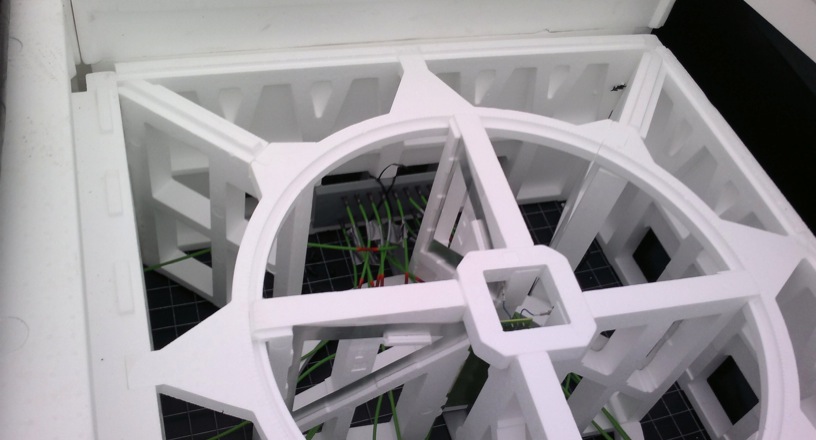
The green cables seen inside the HBA tile are connected to the summator, which is responsible for the first level of coarse grained beam forming, implemented using a set of switchable delay lines.    

Installing the summators.

Thursday, 5 April 2012

Prototype LBA platforms

As we did with the HBA platform in 2010, we also decided to try out several different prototypes of the LBA antenna platforms in 2011. This is mainly because the terrain at the planned location for the LBA field is even more unstable than the land under the HBA field. In the end, we ended up with three different prototypes. The wintering of these prototypes will tell us about the ground movements caused by permafrost, and also give us some experience on the rigidity of these designs. 

Earlier on, this approach was also investigated by modeling the effect of the raised ground mesh to the single element beam pattern. 

1.0 Simple platform reminiscent of the HBA platform. 

2.0. Turnable ground plane and three height adjustable legs. 

3.0 Turnable ground plane, anchored and adjustable legs.