

Showing posts with label aurora. Show all posts
Showing posts with label aurora. Show all posts
Tuesday, 25 February 2014
Digital painting of the aurora
The last slide of the first KAIRA presentation at the Inverse Problems working group at Luosto was a digital painting, created by the author. Today we are featuring it on the web log for others to enjoy.

Monday, 30 December 2013
Unreal photographs
There are some stunning photographs of the aurora, wildlife and the Arctic landscape these days. Better cameras, more photographers and better knowledge help. And, sure enough, the opportunities to catch those stunning moments increase. With the Internet, these are readily distributed and reach a huge audience.
Sadly, however, there are a number of altered photographs out there, which distort our perception of reality. These photographs may not be intentionally altered to deceive, but the original captions, the original context and the original audience is lost as they are circulated about the web via a plethora of social media channels.
It is only by actually having been in these places and seen these things that a few of us have the perception to recognise such alterations. Like the old depictions of lions by northern Europeans in the medieval period, they are laughable if you know what a real lion actually looks like.
But we have this with many modern Arctic photographs. Sure, the quality of the alteration is sophisticated, but many who do not know better see this as reality... which it is not.
Allow me to give an example.
In the last week or so, there have been a very popular image doing the rounds of a polar bear in front of the aurora. Of course, the world has been "ooooh" and "aaaahh" and "what a beautiful photograph". Here is the first version that I saw, posted by Animal Planet (@MeetAnimals on Twitter)...
As an astronomer/geophysicist working in the Arctic, I'm used to seeing the northern lights. I also have done some astrophotography (both as an amateur and professionally). What immediately struck me about the image was the contrast in the lighting and the implied exposure-time requirements. Something didn't look right.
Because the Earth rotates, the sky appears to move. To get the stars to appear as pin-pricks, you need a relatively short focal-length on the camera, or you need to have a tracking platform, or you need a really big lens which has huge light-gathering power. The lens for the star field was definitely wide-angle, as you can see part of Ursa Major at the top and the bright star Alpha Boötes (above and to the left of the bear's head). This puts the vertical field-of-view at about 60 degrees. At a quick guess, I'd estimate that would be a 28mm to 35mm lens. That's a fairly wide-angle lens.
So, to the bear...
For a wide angle lens, the bear doesn't seem right. It looks too "flat", meaning that it was taken with a long focal length telephoto lens. Not surprising... given that it is a bear! Then there is the exposure. The lighting levels are not consistent with what I know real aurora to look like. The diffuse "grey" light implies a uniform white light... probably an overcast day or similar.
Given the diffusion of the aurora, this would be a fairly long exposure to get those intensities. That also matches up with the star images. In fact, you you look carefully, there are stars down to Mag. 6.5... for example I can make out HIP 67103. This is below naked-eye visibility. The bear would have to be still for quite a while there.
While the photograph was not impossible (I could contrive a lens/lighting combination that might result in something like that), it seems HIGHLY unlikely. Too unlikely.
I was suspicious.
So, I started trying to find the original. What I wanted to know was the where/when that the photo was taken. Was it in the right place? Did the star patterns match? And... most importantly, what was the camera and lens? Knowing that would help clinch whether this was good photography or good photoshop.
Then, during my search, I found this...
Same bear, but mirror image. And a different sky-scape. This one looks even more unlikely, in terms of exposure inconsistency, but the presence of the first image clinches it.
These are not real.
I checked the original site and, it most clearly states in the fine print that:
... which is great! They are making it quite clear that this is a composite image, which is perfectly valid. That's art, after all.
So, the problem is in the "chinese whispers" that saw the image propagate across the Internet. With each step, it becomes more and more removed from the original and people start taking it at face value to the point where some are talking about nominating it for "photograph of the year".
By no means should one consider composites as problematic. But what is disturbing, is that those who propagate it fail to mention (or do not even know) that it is such an image. The result is a distorted perception of reality in the minds of many who do not have the background or experience to recognise it for what it is. This is a harmless example, but there are implications...
When you know a topic and you see the way that it is portrayed across the media (meaning Internet and other communication channels), you begin to wonder how thin and shallow must all the other things be that we see there and take for granted. Every news report. Every article. Every web post.
The key cornerstone of science is not facts or knowledge, but critical thinking. Questioning and checking. Not knowing, but wanting to find out. And taking nothing at face value, but verifying. When we at least know something, we are given the tool to recognise things and know where to direct our interrogation.
In the meantime, we need to be wary...

... there are a lot of polar bears out there!
References
Sadly, however, there are a number of altered photographs out there, which distort our perception of reality. These photographs may not be intentionally altered to deceive, but the original captions, the original context and the original audience is lost as they are circulated about the web via a plethora of social media channels.
It is only by actually having been in these places and seen these things that a few of us have the perception to recognise such alterations. Like the old depictions of lions by northern Europeans in the medieval period, they are laughable if you know what a real lion actually looks like.
But we have this with many modern Arctic photographs. Sure, the quality of the alteration is sophisticated, but many who do not know better see this as reality... which it is not.
Allow me to give an example.
In the last week or so, there have been a very popular image doing the rounds of a polar bear in front of the aurora. Of course, the world has been "ooooh" and "aaaahh" and "what a beautiful photograph". Here is the first version that I saw, posted by Animal Planet (@MeetAnimals on Twitter)...
 |
| Posted on Twitter by @MeetAnimals |
As an astronomer/geophysicist working in the Arctic, I'm used to seeing the northern lights. I also have done some astrophotography (both as an amateur and professionally). What immediately struck me about the image was the contrast in the lighting and the implied exposure-time requirements. Something didn't look right.
Because the Earth rotates, the sky appears to move. To get the stars to appear as pin-pricks, you need a relatively short focal-length on the camera, or you need to have a tracking platform, or you need a really big lens which has huge light-gathering power. The lens for the star field was definitely wide-angle, as you can see part of Ursa Major at the top and the bright star Alpha Boötes (above and to the left of the bear's head). This puts the vertical field-of-view at about 60 degrees. At a quick guess, I'd estimate that would be a 28mm to 35mm lens. That's a fairly wide-angle lens.
So, to the bear...
For a wide angle lens, the bear doesn't seem right. It looks too "flat", meaning that it was taken with a long focal length telephoto lens. Not surprising... given that it is a bear! Then there is the exposure. The lighting levels are not consistent with what I know real aurora to look like. The diffuse "grey" light implies a uniform white light... probably an overcast day or similar.
Given the diffusion of the aurora, this would be a fairly long exposure to get those intensities. That also matches up with the star images. In fact, you you look carefully, there are stars down to Mag. 6.5... for example I can make out HIP 67103. This is below naked-eye visibility. The bear would have to be still for quite a while there.
While the photograph was not impossible (I could contrive a lens/lighting combination that might result in something like that), it seems HIGHLY unlikely. Too unlikely.
I was suspicious.
So, I started trying to find the original. What I wanted to know was the where/when that the photo was taken. Was it in the right place? Did the star patterns match? And... most importantly, what was the camera and lens? Knowing that would help clinch whether this was good photography or good photoshop.
Then, during my search, I found this...
 |
| Found via Internet search. |
Same bear, but mirror image. And a different sky-scape. This one looks even more unlikely, in terms of exposure inconsistency, but the presence of the first image clinches it.
These are not real.
I checked the original site and, it most clearly states in the fine print that:
DIGITAL COMPOSITE: Aurora borealis swirls across the sky over a polar bear standing on a rock on the tundra. (composite of two images)
... which is great! They are making it quite clear that this is a composite image, which is perfectly valid. That's art, after all.
So, the problem is in the "chinese whispers" that saw the image propagate across the Internet. With each step, it becomes more and more removed from the original and people start taking it at face value to the point where some are talking about nominating it for "photograph of the year".
By no means should one consider composites as problematic. But what is disturbing, is that those who propagate it fail to mention (or do not even know) that it is such an image. The result is a distorted perception of reality in the minds of many who do not have the background or experience to recognise it for what it is. This is a harmless example, but there are implications...
When you know a topic and you see the way that it is portrayed across the media (meaning Internet and other communication channels), you begin to wonder how thin and shallow must all the other things be that we see there and take for granted. Every news report. Every article. Every web post.
The key cornerstone of science is not facts or knowledge, but critical thinking. Questioning and checking. Not knowing, but wanting to find out. And taking nothing at face value, but verifying. When we at least know something, we are given the tool to recognise things and know where to direct our interrogation.
In the meantime, we need to be wary...

... there are a lot of polar bears out there!
References
Friday, 12 July 2013
No Friday Photograph
For anyone who writes a web log, or at least tries to do so regularly, you will know that it is a lot of work. Sure, the first few weeks are easy, as there are lots of ideas. And when it is busy, that is also pretty straight forward... assuming you can find a spare moment to upload all the interesting material!
However, then there are the quieter times. During summer vacations. And during long stretches of routine observing, with no site visits, no interesting results, and that plot you were preparing still needs more work (yes, it really does need more work). It is at these times that the web log is tough going. Here at KAIRA, we've been trying to keep a average of five posts a week ever since we've been operational. This has been easy at some times, especially during the build, but just now... hmm... difficult.
So as I was trawling through photographs looking for something (anything!) to post today, it occurred to me that perhaps I should write about something for which there is no photograph.
The other day, I caught a programme about the Secret Life of the Sun. It was a documentary about the Sun, its energy processes and how they affect the Earth. It was an interesting programme, but one thing that caught my attention was when one of the presenters was describing a total solar eclipse. This, of course, is when the Sun's disc is completely covered by the Moon, thus allowing the corona to be seen. For a brief moment, the surroundings are plunged into a special night: the birds sing evensong, the air cools noticably, the shadows sharpen, and then all is dark and the Sun's atmosphere is the only source of illumination. The presented ask how could anyone not be moved by such a spectacle.
Sorry.
I've seen a total solar eclipse. And while I would say it was very nice, and interesting to watch and all, would I call it `moving'? Hmm. No. Not really. Does that mean that I am cold and heartless and untouched by the beauty of the natural world? No. I have seen many moving sights during my time. And the thing that I would call the most moving would be a truly spectacular auroral display.
I've seen a few very good displays, but there was one that really struck at the heart. It was in early 2006 and I was on Svalbard. The EISCAT radar operator, a couple of observers and I were driving back from the radar down to the settlement of Longyearbyen. As we drove along the snowy flats in the polar darkness, the operator (who was driving) slowed down and stopped the vehicle. `It looks like this aurora might be bright', he said. `Shall we take a look?'. Of course we agreed.
For the next 20-30 minutes the sky was set ablaze. The streamers and curtains of blue-green light were vivid, dynamic and full of intricacy. I would almost described them as fractal, in the sense that at the largest scales and the smallest, there was movement, detail and colour. And around the edges, wisps of the most incredible shades of indigo-violet flickered and leapt in keeping with the sweeps and whorls of the main display.
On my eyelashes were frozen tear drops.
No-one said a word, and even after the display had passed and had vanished over the horizon, we all still stood there awestruck. No one said anything for many minutes until, as if by secret cue, we got back into the vehicle without a word and, shivering, we drove the remainder of the way to Longyearbyen in silence.
There are no photographs for this. No photograph has yet captured the dynamic range of an aurora. The movement, the changes in shade and brightness. On a photograph, they are blurred out. There is no context. Even the colours are often wrong, being some parrot green, just because the CCD chips in modern digital cameras cannot cope with pure monochromaticism from the different transitions in the aurora.
Yes, I could drag out some old photograph or find a stock image on the web, but it would not be the same.
Thus, for today, there is no photograph.
On the images indelibly etched in my mind's eye.
However, then there are the quieter times. During summer vacations. And during long stretches of routine observing, with no site visits, no interesting results, and that plot you were preparing still needs more work (yes, it really does need more work). It is at these times that the web log is tough going. Here at KAIRA, we've been trying to keep a average of five posts a week ever since we've been operational. This has been easy at some times, especially during the build, but just now... hmm... difficult.
So as I was trawling through photographs looking for something (anything!) to post today, it occurred to me that perhaps I should write about something for which there is no photograph.
The other day, I caught a programme about the Secret Life of the Sun. It was a documentary about the Sun, its energy processes and how they affect the Earth. It was an interesting programme, but one thing that caught my attention was when one of the presenters was describing a total solar eclipse. This, of course, is when the Sun's disc is completely covered by the Moon, thus allowing the corona to be seen. For a brief moment, the surroundings are plunged into a special night: the birds sing evensong, the air cools noticably, the shadows sharpen, and then all is dark and the Sun's atmosphere is the only source of illumination. The presented ask how could anyone not be moved by such a spectacle.
Sorry.
I've seen a total solar eclipse. And while I would say it was very nice, and interesting to watch and all, would I call it `moving'? Hmm. No. Not really. Does that mean that I am cold and heartless and untouched by the beauty of the natural world? No. I have seen many moving sights during my time. And the thing that I would call the most moving would be a truly spectacular auroral display.
I've seen a few very good displays, but there was one that really struck at the heart. It was in early 2006 and I was on Svalbard. The EISCAT radar operator, a couple of observers and I were driving back from the radar down to the settlement of Longyearbyen. As we drove along the snowy flats in the polar darkness, the operator (who was driving) slowed down and stopped the vehicle. `It looks like this aurora might be bright', he said. `Shall we take a look?'. Of course we agreed.
For the next 20-30 minutes the sky was set ablaze. The streamers and curtains of blue-green light were vivid, dynamic and full of intricacy. I would almost described them as fractal, in the sense that at the largest scales and the smallest, there was movement, detail and colour. And around the edges, wisps of the most incredible shades of indigo-violet flickered and leapt in keeping with the sweeps and whorls of the main display.
On my eyelashes were frozen tear drops.
No-one said a word, and even after the display had passed and had vanished over the horizon, we all still stood there awestruck. No one said anything for many minutes until, as if by secret cue, we got back into the vehicle without a word and, shivering, we drove the remainder of the way to Longyearbyen in silence.
There are no photographs for this. No photograph has yet captured the dynamic range of an aurora. The movement, the changes in shade and brightness. On a photograph, they are blurred out. There is no context. Even the colours are often wrong, being some parrot green, just because the CCD chips in modern digital cameras cannot cope with pure monochromaticism from the different transitions in the aurora.
Yes, I could drag out some old photograph or find a stock image on the web, but it would not be the same.
Thus, for today, there is no photograph.
On the images indelibly etched in my mind's eye.
Saturday, 16 March 2013
CME predictions

The following is from the Naval Research Laboratory Solar Physics Branch
H3DMHD predict CME (March 15, 2013, 06:54: COR2A/B) driven shock will arrive at Earth at 00UT on March 17, 2013.
Estimated speed of CME from COR2 of STEREO-A/B is ~1000 km/s.
Source region of this CME located at N09W02.
Here are some links to the animations from the simulation results.
CME_20130315_1000km_N09W02/D_S7_1000km_N09W02.gif

CME_20130315_1000km_N09W02/V_S7_1000km_N09W02.gif

CME_20130315_1000km_N09W02/V_W0_1000km_N09W02.gif

CME_20130315_1000km_N09W02/D_W0_1000km_N09W02.gif

Thanks to RAL Space for bring these to our attention!
CME to coincide with KAIRA/EISCAT observations?
It looks like we may be up for some interesting solar activity soon. And, as luck would have it, we have dual KAIRA/EISCAT observations scheduled for that time. A perfect opportunity to test some of our new riometry experiments.
Here is one of the first reports we received. And it really looks like the BBC's Shipping Forecast, no?
Here is one of the first reports we received. And it really looks like the BBC's Shipping Forecast, no?
SUBJ: IPS DAILY SOLAR AND GEOPHYSICAL REPORT
ISSUED AT 2330UT/15 MARCH 2013 BY IPS RADIO AND SPACE SERVICES
FROM THE AUSTRALIAN SPACE FORECAST CENTRE
SUMMARY FOR 15 MARCH AND FORECAST FOR 16 MARCH - 18 MARCH
STATUS INDICATORS SOL:** YELLOW **   MAG:** RED **     ION: ** YELLOW **
-----------------------------------------------------------
1A. SOLAR SUMMARY
Activity 15 Mar:  Moderate

Flares    Max     Fadeout    Freq.  Sectors
  M1.2    0709UT  possible   lower  Mid East/Indian

Observed 10.7 cm flux/Equivalent Sunspot Number for 15 Mar: 123/76


1B. SOLAR FORECAST
             16 Mar             17 Mar             18 Mar
Activity     Low to moderate    Low to moderate    Low to moderate
Fadeouts     Possible           Possible           Possible
10.7cm/SSN   120/72             120/72             115/66

COMMENT: Solar activity has been Moderate with a long duration
M1 flare from region AR1692(N09E06) peaking around 07UT. A halo
CME was observed in association with this event in SOHO/LASCO
coronagraphs. Combined with STEREO coronagraph imagery, analysis
suggests that the main part of the CME appears to be directed
to the east and north, however a significant amount of the material
is likely directed towards the Earth. This is expected to arrive
late on the 16th of March or early on the 17th UT. A weak shock
was seen in the ACE solar wind data just before 05UT on the 15th
of March, most likely the arrival of the CME observed on the
12th of March. The solar wind speed peaked just below 500 km/s
before diminishing to around 450 km/s. The IMF Bz component went
as low as -10nT for less than an hour before swinging northward
for the remainder of the day. More significant solar wind speeds,
potentially up to around 800 km/s, are expected following the
arrival of the CME observed on the 15th. Solar activity is expected
to be low to moderate for the next 3 days, with some chance of
further M class flare activity.
Saturday, 2 March 2013
A Night of Northern Lights
Last night the Northern Lights appeared early above Sodankylä. The western horizon wasn't even completely dark yet. Here is a short time-lapse film spanning of this fantastic night of observations with the All-Sky Camera of the Sodankylä Geophysical Observatory (SGO), Sodankylä, Finland.
The film covers the night of 1st/2nd March 2013.
The all-sky camera uses a fish-eye lens with 180° field of view pointing vertically up. It takes grey-scale images through filters of green, blue and red. The green image is taken every 20 seconds, the red and blue images are taken once per minute. These images are then overlaid to make an RGB (false-)colour image. The blue and red images are recycled to cover those green frames, for which there's no red or blue data. This sometimes results in blue lights being out of place. But this is a small price to pay for the overall colour effect.
Enjoy!
Sunday, 18 November 2012
Aurora over the E3D meeting
During the EISCAT_3D "all-hands" meeting, we were treated to some mostly-clear skies and a bit of auroral activity too.
 |
| Some of the delegates at the E3D "all-hands" meeting. Photo: Esa Turunen |
Sunday, 17 July 2011
Northern Lights Route
 Between the busy Norwegian port of Tromsø and the Fenno-Swedish border towns of Tornio-Haparanda on the Gulf of Bothnia, there is the Northern Lights Route.
This route comprises a section of the roads E8 and R99 which run inland from the Norwegian coast, passing the KAIRA site, crossing into Finland at Kilpisjärvi, and then down along the border between Finland and Sweden until it reaches the coast of the Gulf of Bothnia, on the Baltic Sea. Throughout this region, the Aurora Borealis (Northern Lights) are sometimes visible during the hours of darkness (solar and terrestrial weather conditions permitting, of course).
It is a long way — some 610 km — and it would take at least 9 hours to drive it (some of the route is strictly restricted to 'slow speed', to protect reindeer herds).
Along the way, there are numerous signs marking interesting lookout points. When the aurorae are present, they are very photogenic owing to the scenic landscape thereunder.
The Northern Lights Route sign is marked with a five-ribbon motif. Clockwise from the top-right, these are the Sami, Finnish, Swedish and Norwegian flags. The ribbon that ties them together is in the design of a marked road.
The photograph was taken just a few kilometres from the KAIRA site. There is a small carpark there, which also marks the start of several walking trails (including one to the point where the three countries of Finland, Norway and Sweden meet). You can also walk down to the lakeside there, from which the Northern Lights over the water of Kilpisjärvi itself would be quite a sight.
Hopefully we'll be able to get some photographs from there later in the year when the darkness returns. The first sunset is still a few weeks off... let alone any proper darkness.
Website: http://www.northernlightsroute.com/
Wednesday, 30 March 2011
Is there aurora above Kilpisjärvi?
Several optical instruments measure continuously whenever the sky above northern Finland is dark. These instruments come in many versions with different purposes:
One of the Finnish MIRACLE all-sky camera stations is at Kilpisjärvi close to KAIRA. At the same station the University of Oulu deploys its optical instruments during the winter season. However, Kilpisjärvi is often overcast so look also at
- Meridian-scanning photometers scan the sky looking at one position at a time and measure one or more auroral emissions.
- All-sky colour cameras have fisheye optics and nowadays image detectors with colour filter masks. Previously 16-mm or 35-mm cinematographic film was used. These cameras reproduce the aurora as it looks to the human eye.
- Wide-band imagers are essentially sensitive black-and-white video cameras. They are useful for studying the structure (morphology) of the aurora, that is, to use the magnetosphere as a giant plasma physics lab.
- Spectral imagers use narrow-band optical filters to measure the main auroral emissions quantitatively. From this the energy of the electrons impinging upon the atmosphere, causing the aurora, can be determined.
One of the Finnish MIRACLE all-sky camera stations is at Kilpisjärvi close to KAIRA. At the same station the University of Oulu deploys its optical instruments during the winter season. However, Kilpisjärvi is often overcast so look also at
Friday, 18 March 2011
EISCAT Svalbard Radar — Part 3
There was one last photograph to share while we're on the topic of the EISCAT Svalbard Radar (ESR). I had intended to post it at the end of yesterday's web-log entry, but it was such a beautiful photograph that I decided to save it for a Friday. (This Friday-Photo is starting to become a regular feature!) So, although yesterday's post was a bit short, hopefully this will make up for it.
The photograph is of the ESR 42m dish during polar night. The stunning green of the Aurora Borealis (northern lights) is clearly visible. The bright red glow is the aircraft warning light on the top of the dish. And, if you look carefully, you can make out some of the stars in the inky-black Arctic sky. The photograph was taken by Alan Wood from University of Aberystwyth during a radar campaign in January 2006.
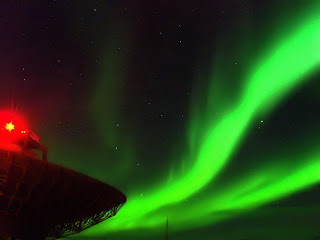 ESR 42m and aurora. (Photo: Alan Wood)
Have a nice weekend.
The photograph is of the ESR 42m dish during polar night. The stunning green of the Aurora Borealis (northern lights) is clearly visible. The bright red glow is the aircraft warning light on the top of the dish. And, if you look carefully, you can make out some of the stars in the inky-black Arctic sky. The photograph was taken by Alan Wood from University of Aberystwyth during a radar campaign in January 2006.
 ESR 42m and aurora. (Photo: Alan Wood)
Have a nice weekend.
Subscribe to:
Posts (Atom)