 |
| New electronics boards from ASTRON (Photo: D. McKay-Bukowski) |

Showing posts with label delivery. Show all posts
Showing posts with label delivery. Show all posts
Wednesday, 10 September 2014
Replacement parts
We've just had some parts arrive from ASTRON. The timing distribution boards are being replaced and so we had three arrive in a box from Dwingeloo. The "Fragile Glass" label on the box got us excited for a moment, but even without any bottles therein, the arrival of new electronics is cool! These will be installed on our next trip to the site and the recovered old boards will be sent back to ASTRON.

Saturday, 30 July 2011
The tooling returns
Some of the tools that were used to install the LOFAR HBA tiles at the KAIRA site were provided by ASTRON (the Netherlands Foundation for Radio Astronomy). These tools move from site to site as the stations are rolled out across Europe. Now that the installation work is complete, the equipment used in the operation needs to returned.
 The unfolding station, generators, tool boxes and spare parts are loaded onto the return lorry.
 The unfolding station, generators, tool boxes and spare parts are loaded onto the return lorry.
Tuesday, 26 July 2011
Electronics and cables
As part of the recent delivery, we received a lot of electronics, cables and ancillary equipment. We spent a bit of time moving things around and getting organised for the week.
 Santtu Rantakokko and Marko Kauranen shift the sub-rack
assemblies from the Land Cruiser into the auxiliary container.
In addition to the electronics, there are a lot of cables. In fact a total of 576 signal cables were delivered, with a total length of 27268 metres!
Of that distance, 96 cables (nearly 10 km in total) will be deployed as soon as possible onto the HBA field. The remaining cables are either for the RF-container or for the LBA installation for next year. Although the quality of the supplied cables, we checked every single one for the signal attenuation and group delay to ensure that it is correct before taking it over to the RF-container for installation.
 Juha Vierinen uses the network analyser to check one of the cables.
This work is being done in the so-called Lehtinen Barracks.
We spent a couple of evenings and one work day sorting out the measurement technique and then checking all the HBA field cables. The work went very quickly and the team's progress was outstanding.
Once the testing was completed the cables were taken out to the RF-container where they are stacked ready for feeding through the cable ducts to connect to the antennas.
 Santtu Rantakokko and Juha Vierinen unload cables from the Land Cruiser to the RF-container.
 Stacks of 115m cables in the RF-container, ready to go!
 Santtu Rantakokko and Marko Kauranen shift the sub-rack
assemblies from the Land Cruiser into the auxiliary container.
In addition to the electronics, there are a lot of cables. In fact a total of 576 signal cables were delivered, with a total length of 27268 metres!
Of that distance, 96 cables (nearly 10 km in total) will be deployed as soon as possible onto the HBA field. The remaining cables are either for the RF-container or for the LBA installation for next year. Although the quality of the supplied cables, we checked every single one for the signal attenuation and group delay to ensure that it is correct before taking it over to the RF-container for installation.
 Juha Vierinen uses the network analyser to check one of the cables.
This work is being done in the so-called Lehtinen Barracks.
We spent a couple of evenings and one work day sorting out the measurement technique and then checking all the HBA field cables. The work went very quickly and the team's progress was outstanding.
Once the testing was completed the cables were taken out to the RF-container where they are stacked ready for feeding through the cable ducts to connect to the antennas.
 Santtu Rantakokko and Juha Vierinen unload cables from the Land Cruiser to the RF-container.
 Stacks of 115m cables in the RF-container, ready to go!
LBA grids
Underneath each Low Band Array (LBA) antenna, there is a metal grid. This mesh is 3m × 3m and is made of reinforcing steel. Along with the RF and auxiliary containers, we also received delivery of a load of 100 of these steel grids.
Unloading them proved to be non-trivial.
The grids were in two stacks of 50 pieces, each probably over a tonne. By itself, this is not so much of a problem. However they are abrasive, flexible, awkward to handle and... with jagged edges.
During the first lift one of our lifting straps broke, causing the load to crash to the ground. Damage was minimal, and no-one was hurt, but it gave us a bit of a scare.

With new lifting rigs we made the attempt again. In the next photograph, Marko Kauranen and Santtu Rantakokko secure a set of lifting chains.

The next attempts managed to get the grids into place.

Finally... a stack of LBA grids. Ready for next year.

Photos: D.McKay-Bukowski
Unloading them proved to be non-trivial.
The grids were in two stacks of 50 pieces, each probably over a tonne. By itself, this is not so much of a problem. However they are abrasive, flexible, awkward to handle and... with jagged edges.
During the first lift one of our lifting straps broke, causing the load to crash to the ground. Damage was minimal, and no-one was hurt, but it gave us a bit of a scare.

With new lifting rigs we made the attempt again. In the next photograph, Marko Kauranen and Santtu Rantakokko secure a set of lifting chains.

The next attempts managed to get the grids into place.

Finally... a stack of LBA grids. Ready for next year.

Photos: D.McKay-Bukowski
Auxiliary container
The next item on the delivery lorry for 25th July 2011, was the auxiliary container.

This container provides additional storage. It also came with various pieces of equipment inside that would be needed for the installation.

Unlike the RF-container, unloading and placing this was pretty straight-forward. However, the following load proved to be difficult and dangerous. Stay tuned!
Photos: D. McKay-Bukowski

This container provides additional storage. It also came with various pieces of equipment inside that would be needed for the installation.

Unlike the RF-container, unloading and placing this was pretty straight-forward. However, the following load proved to be difficult and dangerous. Stay tuned!
Photos: D. McKay-Bukowski
RF-container
Yesterday (25th July 2011) we received a pretty big delivery. A road train arrived with two shipping containers and a couple of stacks of steel grids.

The first container (brown) is the auxiliary container. This will be used for additional storage capacity on the site (shipping containers are cheaper and easier to reposition than permanent structures). However, this was not the first to be unloaded and put in place.
The second container (the grey one) is the RF-container. For those who have been following this web log (we admire your endurance!), you will know that this shipping container is shielded against electrical noise and will house the bulk of the digital signal processing electronics.
To get it from the delivery lorry to the northern corner of the array, we used the trusty 15-tonne digger. After a delicate moment trying to negotiate the forks into the container lifting slots we eventually managed it and drove it down to the array end through the rain.

The final stretch was quite difficult. Apart from the turns and the slope, there was an open trench from the electrical power cabling. Although we had hoped to leave this open to make the post-installation work easier, we realised that this was not going to be possible, so the team rapidly filled in the trench while the digger waited with the 5-tonne container held precariously aloft.

With the area ready, we hauled open the container doors (so we could feed in the cable ducting). Then it was time to move and lower the container onto the concrete foundation blocks.

Getting this into position was not easy and we needed to to-and-fro multiple times to get the alignment just right. Credit is due to the digger driver who did an expert job of getting this just right.

Once in place, the then attempted to extricate the digger forks. However, by this time, the angle of the digger and the weight shift of the container had jammed them in hard and any attempt to pull free was bringing the container along with it!
After numerous frustrated attempts, Rauno Oikarainen hit upon the idea of knocking them out from the opposite side with lengths of timber and a sledge hammer. So, we disconnected the digger from the forks, backed it off, and then proceeded to successfully accomplish the task.
Phew!
That was a difficult and time consuming process, but the container was now in place. More unloading to follow... in the next article!

The first container (brown) is the auxiliary container. This will be used for additional storage capacity on the site (shipping containers are cheaper and easier to reposition than permanent structures). However, this was not the first to be unloaded and put in place.
The second container (the grey one) is the RF-container. For those who have been following this web log (we admire your endurance!), you will know that this shipping container is shielded against electrical noise and will house the bulk of the digital signal processing electronics.
To get it from the delivery lorry to the northern corner of the array, we used the trusty 15-tonne digger. After a delicate moment trying to negotiate the forks into the container lifting slots we eventually managed it and drove it down to the array end through the rain.

The final stretch was quite difficult. Apart from the turns and the slope, there was an open trench from the electrical power cabling. Although we had hoped to leave this open to make the post-installation work easier, we realised that this was not going to be possible, so the team rapidly filled in the trench while the digger waited with the 5-tonne container held precariously aloft.

With the area ready, we hauled open the container doors (so we could feed in the cable ducting). Then it was time to move and lower the container onto the concrete foundation blocks.
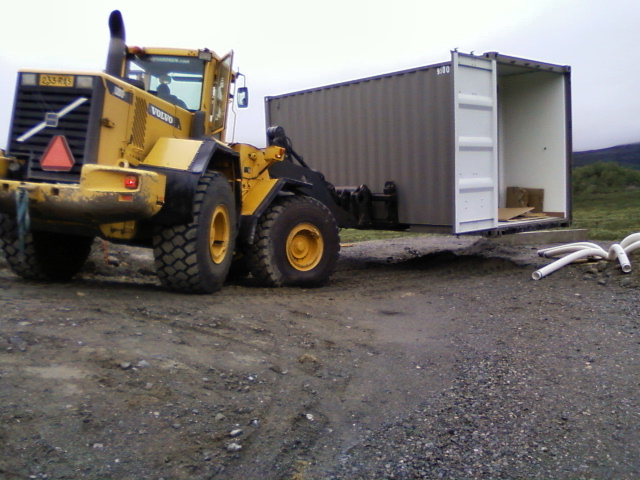
Getting this into position was not easy and we needed to to-and-fro multiple times to get the alignment just right. Credit is due to the digger driver who did an expert job of getting this just right.

Once in place, the then attempted to extricate the digger forks. However, by this time, the angle of the digger and the weight shift of the container had jammed them in hard and any attempt to pull free was bringing the container along with it!
After numerous frustrated attempts, Rauno Oikarainen hit upon the idea of knocking them out from the opposite side with lengths of timber and a sledge hammer. So, we disconnected the digger from the forks, backed it off, and then proceeded to successfully accomplish the task.
Phew!
That was a difficult and time consuming process, but the container was now in place. More unloading to follow... in the next article!
Tuesday, 19 July 2011
Last lorry-load of tiles
The final lorry bearing HBA tiles arrived at the site and was unloaded on the morning of Monday 18th July 2011.
 It was certainly gratifying to see this last empty lorry and know that we are reaching the end of this phase of the project.
 Oh... but there is so much more to go!
 It was certainly gratifying to see this last empty lorry and know that we are reaching the end of this phase of the project.
 Oh... but there is so much more to go!
Wednesday, 13 July 2011
Unloading the lids
On each HBA tile, there are polystyrene 'lids' — one for each of the 16 cells that hold the antenna elements. These are not on the tile when it is folded, so are shipped on separate pallets (although often on the same delivery lorry). These pallets also need to be unloaded and stored.

Because they are quite tall, and are very light, it is important that they are secured against the high winds that often occur at the Kilpisjärvi site.
Photo: D. McKay-Bukowski

Because they are quite tall, and are very light, it is important that they are secured against the high winds that often occur at the Kilpisjärvi site.
Photo: D. McKay-Bukowski
Saturday, 9 July 2011
Storage stacks
This photograph shows the arrangement for storing the tiles. On the right is the 'storage container' (a converted shipping container). There are three tiles resting against it (the spare tile, and two new ones).

The Lehtinen Barracks stands higher and can be seen behind the stored tiles (although they are not resting on it per se). The barracks are also used as a resting point for tiles and tile lids. In the left background, there is a partially unloaded lorry and further back (behind the trees on the main road), there is another lorry waiting to come on to the site.

The Lehtinen Barracks stands higher and can be seen behind the stored tiles (although they are not resting on it per se). The barracks are also used as a resting point for tiles and tile lids. In the left background, there is a partially unloaded lorry and further back (behind the trees on the main road), there is another lorry waiting to come on to the site.
Monday, 4 July 2011
Unloading HBA tiles
Once the lorries have arrived and driven down onto the site itself, it is time to unload them and place the tiles in the storage area. The tiles are unloaded from the side of the lorry.
 There is not a lot of clearance, so they have to be lifted out carefully.
 As it turned out, the front tiles had slid forwards slightly, so that they could not come straight out directly. What we needed to do, was lift the tile slightly and then get the lorry to drive forward. For a brief moment, there was a sense of 'relativistic confusion' as the movement of the lorry, made it look like the tile and front-loader were sliding the other way!
Once safely out of the lorry, the tile is taken across the site to the storage area.

The tiles are lined up against the storage container and the barracks, to provide stability in the event of high winds.

Today (4th July 2011) we received two lorry-loads (8 HBA tiles in total). These are now all safely in storage. Due to the other organisation work, training and set-up, we did not attempt to deploy any framesets or tiles onto the array. That will be tomorrow!
Photos: D. McKay-Bukowski
 There is not a lot of clearance, so they have to be lifted out carefully.
 As it turned out, the front tiles had slid forwards slightly, so that they could not come straight out directly. What we needed to do, was lift the tile slightly and then get the lorry to drive forward. For a brief moment, there was a sense of 'relativistic confusion' as the movement of the lorry, made it look like the tile and front-loader were sliding the other way!
Once safely out of the lorry, the tile is taken across the site to the storage area.

The tiles are lined up against the storage container and the barracks, to provide stability in the event of high winds.

Today (4th July 2011) we received two lorry-loads (8 HBA tiles in total). These are now all safely in storage. Due to the other organisation work, training and set-up, we did not attempt to deploy any framesets or tiles onto the array. That will be tomorrow!
Photos: D. McKay-Bukowski
The arrival
 The first lorries with LOFAR HBA tiles have arrived at the KAIRA site at Kilpisjärvi. They have travelled from the Netherlands to Lübeck, then a boat to Kemi, before driving up to Kilpisjärvi.
Two of these lorries arrived (actually the previous evening) and were ready to unload this morning. That made for a very frantic Monday-morning start, as we had originally anticipated at least a few hours this morning to clear the site, move vehicles and do the last patch of ground levelling.
Yet the work was done quickly and efficiently and unloading would soon be able to commence.
 Each lorry contains four HBA tiles. The tiles are stored 'folded' for transportation. In this configuration, the are approximately 5 metres long, 1 metre wide and 2.5 metres high. In addition to the four folded tiles, each lorry also contains 4 pallets with 'tile lids'.
Although it takes up a huge volume, the load is quite light... just over 1 tonne. When we received the delivery of the test tiles for last winter, the drivers mentioned that the load can be tricky at times if driving in high winds.
Still, these have made it here safely and will be unloaded soon.
Photos: D. McKay-Bukowski
Subscribe to:
Posts (Atom)